How Does Astronomy Provide Evidence for God?
Does astronomy point to a Creator? This article explores how the universe's origins, fine-tuning, and vastness provide evidence for God, especially relevant for a Jewish audience.
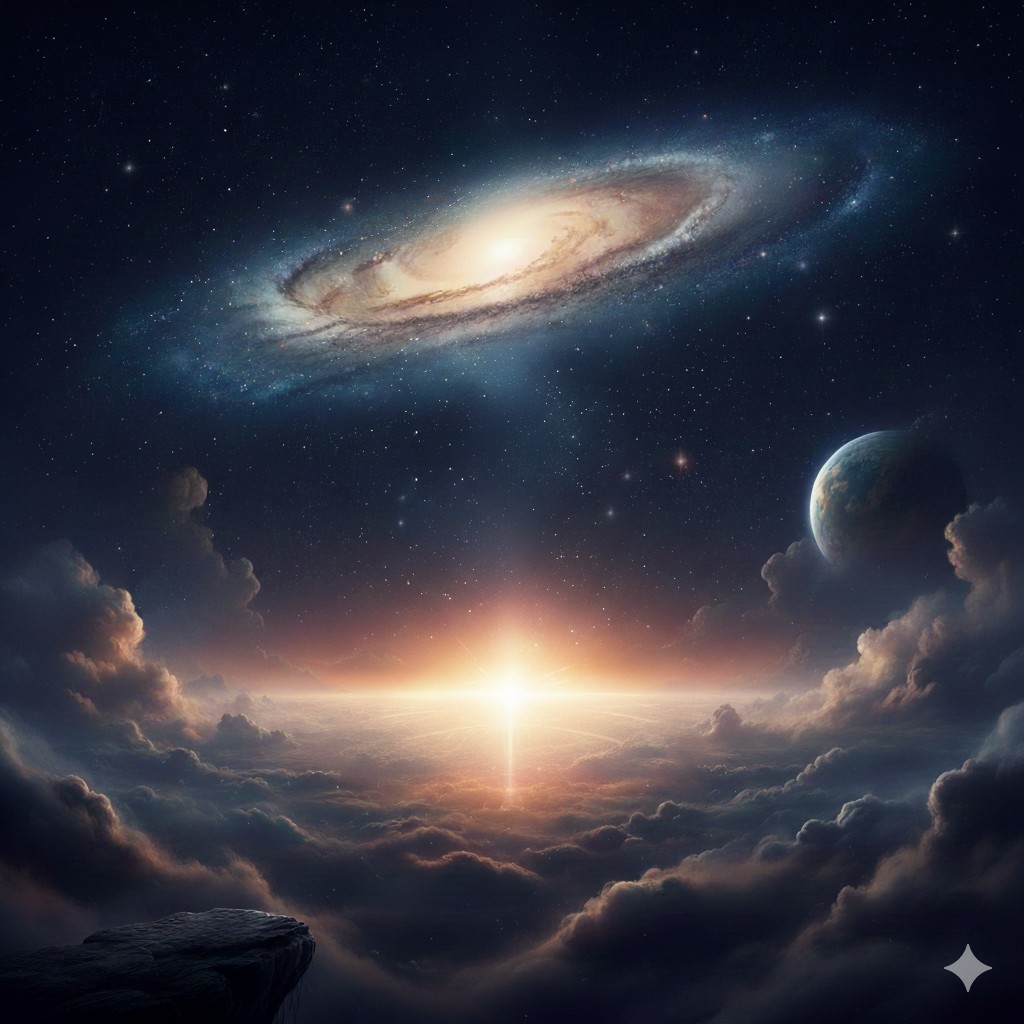
Have you ever looked up at the night sky and wondered what’s out there and where it all came from? Where we came from? You may be surprised to find out that the evidence for the universe’s beginning points to God. In fact, the Bible encourages the observer of the stars to allow the vastness of space to transfix his gaze onto the transcendent one beyond the stars: “The heavens declare the glory of God, and the sky above proclaims his handiwork,” (Psalm 19:1). The millions of galaxies, billions of planets, and the trillions of stars all give evidence to the creation of the universe by God.
1. What Really is the Big Bang Theory?
The standard cosmological model for mainstream science is the Big Bang theory. It posits that the universe came into being in an instant.[1] By looking at what is known as a “redshift,” astronomers can determine that the universe is constantly expanding. A “redshift” is when light is stretched out and shifted toward the red end of the spectrum.[2] There are many ways that light can be redshifted: motion, the “Doppler effect,” gravity, and expansion of the universe.[3] When scientists trace the redshift in reverse, they can deduce that the universe emerged from a single point in spacetime called a singularity. A singularity is a point of infinite density and zero spacetime curvature.[4] However, the Big Bang model has numerous issues that make it impossible for the universe to have created itself by chance.[5] This leaves a cosmological hole in the Standard Model: If there was a Big Bang, what caused it?
Because of the first law of thermodynamics, also known as the conservation of energy, matter can neither be created nor destroyed.[6] According to the laws of physics, energy cannot come into existence naturally. If all matter had a cause, and matter cannot be naturally created, then that cause could not have been matter itself. Without matter, there would have been no laws of physics. If the initial singularity had not expanded, then there was not yet time. If the cause was not energy and was immaterial, timeless, and operated beyond the laws of physics, then what cause fits this data?
2. The Big Bang Theory: Friend or Foe?
It is not without reason that we believe the most probable cause that fits the data is the God of the Bible. The Bible describes God as an immaterial, eternal, omnipotent, and personal being who has the ability to create everything—even a Big Bang—out of nothing. The Bible teaches in the first chapter of the book of Genesis that God created the earth, the sun, the stars, the planets, the nebulae, and everything else in the universe. It indicates that our planet is a sphere (Job 26:10; Isaiah 40:22), and it also tells us that the earth floats in space (Job 26:7). It would appear that the existence of such a God is sufficient to answer how the universe came to be, in just the way we experience it.
We can also reach this conclusion by looking at what resulted after the initial singularity. So far, NASA has discovered 4,158 exoplanets (planets outside of our solar system).[7] Of these exoplanets, only a very small fraction is situated in their stars‘ habitable zones.[8] To date, not one single planet other than Earth has shown any signs of life.[9] Why were we so lucky? Earth’s precise location in space and its ability to sustain life is exceptionally unlikely. The sun is 93 million miles away from the earth. If it were a little closer, we would all burn to death, and if it were a little farther, we would all freeze to death. Why does the earth remain in a steady-state relationship with the sun whereby life can thrive? Blind chance is non-credible, especially in light of other perfectly tuned factors that enable the earth to support life. Some scientists have even written that Earth is situated in “the Goldilocks Zone,” which means that it is perfectly placed in space to support life.[10] These statistics give additional weight towards the conclusion that God created a planet specifically for us.
When we look through the telescope and into the stars, we find a cosmos that aligns with the descriptions given in the Bible. God created all of what we know, expanded the universe, and placed the Earth in the perfect location so we could thrive. The universe works so seamlessly that it could only have been designed by an intelligent being for a particular purpose. This aligns perfectly with the story of the Bible and its main character, the God and Creator of the world.