Does the Torah Contain Errors?
Discover insights on the Torah's divine origin and preservation while learning how to deal with the errors in the manuscripts we have available today.

“If you change the resh into a daleth, you bring as a result destruction upon the world.”
“The eighth fundamental principle is that the Torah is from heaven, that we should believe that the entire Torah that we possess today is the Torah that was given to Moses, and that it is of Godly origin in its entirety.”[1]
והיסוד השמיני הוא - תורה מן השמים. והוא, שנאמין שכל התורה הזו הנמצאת בידינו היום הזה היא התורה שניתנה למשה, ושהיא כולה מפי הגבורה[2]
—Maimonides’s Eighth Principle (twelfth century)
“The Torah which we have to-day and which has been handed down to us by unbroken tradition from father to son is the same that was given to Moses on Sinai, without any change. It could not have received change in the time of the first temple when the priests and teachers were in the temple and the Torah was well known to everybody.”[3]
—Rabbi Joseph Albo (fifteenth century)
1. The Traditional Claim: The Torah We Have Today is Perfect
According to common Orthodox Jewish thought, the written Torah is a holy, perfect, and godly book in the form that we have it today. Not only was the Torah given to Moses supernaturally at Sinai, but it has also been preserved supernaturally until today, right down to the very letter. This principle of faith is not negotiable, according to Rambam’s eighth principle. In the ArtScroll Stone Edition Chumash, Rabbi Nosson Scherman comments,
In several of his writings, Rambam sets forth at much greater length the unanimously held view that every letter and word of the Torah was given to Moses by God; that it has not been and cannot be changed; and that nothing was ever or can ever be added to it. Indeed, the Talmud states emphatically that if one questions the Divine origin of even a single letter or traditionally accepted interpretation of the Torah, it is tantamount to denial of the entire Torah (Sanhedrin 99a). This harsh judgment is quite proper, for if a critic can take it upon himself to deny the provenance of one verse or letter of the Torah, what is to stop him from discarding any part that displeases him?[4]
At Chosen People Answers, we affirm the authority and divine origin of the Hebrew Scriptures. Moses indeed received the Torah from Hashem at Sinai, and the Nevi’im and Ketuvim are also from Heaven. However, in light of the evidence provided by many biblical manuscripts, we cannot follow the traditional Jewish position that there are no errors in the textual transmission of the Torah. We do not possess the original manuscripts that Moses or the prophets wrote upon. As we will discuss below, one can demonstrate that there are indeed differences in the post-Moses textual tradition of the written Torah. To accurately follow the inspired words of Moses and the prophets, a biblical scholar needs tools to identify which verses and words have been corrupted over time in the manuscript copying process. This approach to the text does not challenge our faith, but actually strengthens it.
Although it may seem counterintuitive, we believe it is potentially destructive to one’s faith in the God of Israel to believe that Torah manuscripts have no errors. All one must do is compare two Hebrew manuscripts; if discrepancies are found, will our trust in Hashem flounder? If one’s faith states that there are no discrepancies, then what can one do when multiple discrepancies are found?
We believe faith can withstand manuscript errors when we understand that humans make mistakes in transmitting the original holy text. This article will illuminate multiple examples of textual discrepancies in the Masoretic Text,[5] and we will plot a course for retaining an informed and reasonable belief in the authority of the Scriptures in light of the discrepancies—a process called textual criticism.
Instead of being hesitant about textual criticism, we should embrace it, since it enables us to put together an even more authoritative text that better reflects the version God intended his people to have. Why should we blindly defend a text that has demonstrable corruptions in it? Perhaps we should rather seek to restore the text to its original God-given form, to the best of our ability. This is a way to honor the text of Scripture, not subvert it.
Moreover, once we recognize the need for textual criticism to correct the corruptions of the Hebrew manuscript tradition, this opens the door to accurately investigate controversial verses in Jewish-Christian relations. Indeed, some of the verses that Jews and Christians have interpreted differently are based on differing textual traditions. Thus, when discussing the New Testament, knowledge of the process of textual criticism is indispensable.
2. Modern Orthodox Scholarship on the Integrity of the Biblical Text
In his book, The Limits of Orthodox Theology, Modern Orthodox scholar Marc Shapiro investigates Rambam’s eighth principle, specifically the claim that the Torah in our possession today contains no errors whatsoever.[6] This asserts that the Masoretic Text is free from error. Shapiro remarks that this is a common position in Orthodox circles, citing several proponents of the traditional Jewish position today, including J. Newman,[7] Avraham Kushelevsky[8] and Louis I. Rabinowitz.[9] Modern Orthodox Rabbi Josh Yuter discusses the implications of such a position:
The crucial words in Maimonides’ formulation is that the Torah “הנמצאת בידינו” – that we currently possess in our hands – is what God dictated to Moses…. As written, Maimonides’ formulation does not allow for any textual variants since whatever text we have must have been exactly what was transmitted to Moses at Sinai… [O]nce we concede any textual variant in the Torah, Maimonides’ 8th principle is no longer valid.[10]
Referring to the Masoretic text tradition as the textus receptus (standard text), Herbert Loewe concurred: “If the manuscripts of the textus receptus differ in one single iota, the doctrine is irreparably shattered.”[11]
While it is popular belief that the Torah is free from errors, and is reflected in many Orthodox publications, Shapiro uncovers many lines of evidence that illustrate the variations in the Hebrew manuscript tradition. The evidence cited by Shapiro includes:
- Many quotations of the Torah in the Talmud and midrashim differ from the Hebrew text of the Masoretic manuscripts
- Medieval commentators quoted Torah texts slightly differently
- R. Akiva (b. Pesachim 112a) and R. Ammi (b. Ketubot 19b) acknowledged the existence of scrolls that had not been proofread for accuracy
- R. Meir kept a scroll that differed from the other sages (Bereshit Rabbah 9:5)
- The men of the Great Assembly altered some of the words of the Torah (Midrash Tanhuma, Yalkut Hamakhiri)
Shapiro also cites a passage in the Talmud Yerushalmi (y. Ta’anit 4:2), which reads,
Three scrolls did they find in the Temple courtyard…. In one of these scrolls they found it written, “The eternal God is your dwelling place (maon)” (Deut. 33:27). And in two of the scrolls it was written, “The eternal God is your dwelling place” (meonah). They confirmed the reading found in the two and abrogated the other.[12]
The Yerushalmi continues and relates how the sages repeated the same process for a discrepancy in Exodus 24:5 and other passages with variant spellings.
The temple courtyard was where the “authoritative” version of the Tanakh was stored before 70 CE, but the Yerushalmi says that three of the scrolls in the courtyard disagreed. The rabbis compared various things in these three scrolls and found that in certain locations, one scroll sometimes agreed with another scroll and disagreed with another. If all three scrolls were “authoritative,” what was to be done with these differences? The rabbis decided to let the numbers be decisive: In the case of 2-1 splits, the wording of the two scrolls overruled the wording of the one. In sum, the rabbis were practicing what is called today “textual criticism” and their method was to prefer the “majority reading.”
The Talmudic era sages also left comments that imply that the text of Torah was “corrected” by scribes at some point in the past, a phenomenon called tikkune soferim.[13] Moreover, the marginal readings of biblical manuscripts include the qere/kethiv system of corrections, whereby the reader of Scripture is encouraged to read aloud the qere word in the margin of the text, rather than the actual word in the biblical text (kethiv).
Reflecting on these points, Shapiro believes that Maimonides was aware of variations in the manuscript evidence, but he decided to issue “half-truths” as dogma to communicate more easily with the masses.[14] Shapiro writes,
In [Maimonides’s] time, Muslims were challenging the Jews, claiming that they had altered the text of the Torah…. In the face of such an assault, it is not hard to see why Maimonides felt it was important for the masses to believe that their text was the exact equivalent of Moses’ text. The masses then (and today) could not be expected to understand the problems relating to the biblical text. Exposing them to some of this knowledge could have undermined their unquestioned faith, especially in the face of Islamic polemics. It was thus necessary for the masses to affirm what, in reality, was not true, namely, that the text of the Torah in their hands was entirely free from any textual corruptions, even to the last detail.[15]
Thus, Shapiro represents a Modern Orthodox scholar who has investigated the Hebrew manuscript tradition and found reason to question whether it is free from error. This is a separate topic than whether the Torah was given to Moses on Sinai; one can still believe the Torah is from the mouth of Hashem and also admit that minor errors have crept into the manuscripts over time.
But are there really such errors in the Hebrew manuscript tradition?
3. Examples of Discrepancies in the Hebrew Manuscripts
The Masoretes (roughly 600–1000 CE; see Textual Criticism 101) were a community of Jewish scribes who meticulously preserved the Hebrew text and provided the world with the best transcriptions of the Hebrew text known today. Their manuscripts, collectively called the Masoretic Text, form the basis of modern editions of the Bible, both in Hebrew publications and in translations to other languages. The most important and famous of the Masoretic manuscripts is the Leningrad Codex, which is a complete copy of the entire Tanakh, dating to roughly 1009 CE.
Although the Masoretic Text is very reliable and deserves to be seen as the authoritative version of the Scriptures, there are still textual problems with the manuscripts we have. For example, in Deuteronomy 31:1, the Masoretic text says:
וַיֵּלֶךְ מֹשֶׁה וַיְדַבֵּר אֶת־הַדְּבָרִים הָאֵלֶּה אֶל־כָּל־יִשְׂרָאֵל׃“And Moses went and spoke these things to all Israel.”
There are several textual issues with this verse in the Masoretic textual tradition. The first word (וַיֵּלֶךְ) is problematic when we compare it with the equivalent word in the earliest Hebrew manuscript we have for the verse in the Dead Sea Scrolls (1QDeutb), and also three Greek versions of the Torah (G, αʼ, and θʼ). These versions instead say, “And Moses finished speaking” rather than “And Moses went and spoke.” Here is the Hebrew in the Dead Sea Scroll compared to the Masoretic version, with the differences in red:
Masoretic: וַיֵּלֶךְ מֹשֶׁ֑ה וַיְדַבֵּר1QDeutb: ויכל משה לדבר
In the first word, the difference is one of simple transposition. The kaf and the lamed are swapped, leading to verb change. This is an easy scribal mistake that is called metathesis. The second difference is tied to the first grammatically.[16] Some scholars believe the Masoretic Text is defective here, while others believe the Dead Sea Scroll and Greek versions are incorrect. That is a matter of debate based on other factors, but this verse was an example of having two Hebrew manuscripts with different wording and the necessity to figure out which one is correct, if any.
The Deuteronomy 31 example pitted the Masoretic Text against the ancient Dead Sea Scrolls, but the following examples show issues within the Masoretic family of manuscripts. In other words, some rabbinically approved Hebrew manuscripts have one reading and other rabbinically approved Hebrew manuscripts have another. Benjamin Kennicott’s eighteenth-century reference work shows a comprehensive (but not exhaustive) list of Masoretic textual variants.[17] We highlight a few here:
- Genesis 10:4 – The majority of Hebrew manuscripts have “Dodanim” (דֹדָנִים), but some have “Rodanim” (רֹודָנִים). The minority reading is also attested in the Greek Septuagint and the Samaritan Pentateuch. The minority reading also shows up in multiple Hebrew manuscripts in 1 Chronicles 1:7. This is a case where a dalet was mistaken for a resh, or vice-versa.[18]
- Exodus 19:18 – The majority of Hebrew manuscripts say that “the mountain” (הָהָר) trembled, but a few Hebrew manuscripts and the Greek Septuagint say “the people” (הָעָם) trembled.
- Numbers 3:9 – The majority of Hebrew manuscripts say that the Levites are to be given “to him” (לֹו)– that is, Aaron, but a few Hebrew manuscripts, the Samaritan Pentateuch, and the Greek Septuagint all have “to me” (לִי). The minority reading agrees with Numbers 3:12, where God says the Levites are “mine.”
Sometimes, textual problems show up in every Masoretic manuscript, including unclear omissions, grammatical mistakes, and illogical meanings. The following examples are textual problems in all Masoretic manuscripts, not just in a minority of them:
- Genesis 4:8 – The Masoretic manuscripts say, “Cain said to Abel his brother.” The manuscripts end there and do not say what Cain said. This is in contrast to many ancient translations of the Hebrew (Septuagint, Samaritan, Syriac, Vulgate), which give Cain’s actual speech: “Come, let us go out to the field.” This reading is attested from rabbinic circles in Targum Pseudo-Jonathan and Targum Neofiti. For some reason, it is not in the Masoretic manuscripts.
- Judges 18:30 – The Masoretic manuscripts say that the idol-worshipping Jonathan is “the son of Gershom, the son of Manasseh,” but the nun in Manasseh’s name is placed in superscript. The Dead Sea Scrolls and manuscripts of the Septuagint and Vulgate have “Moses” instead of “Manasseh,” that is, the name without the nun. It is likely that the Masoretic scribes did not want an idolator to be associated with Moses, so they added a nun to the consonantal text of Holy Scripture. The ArtScroll commentary states, “Out of respect for Moses a letter was added to mask his name.”[19]
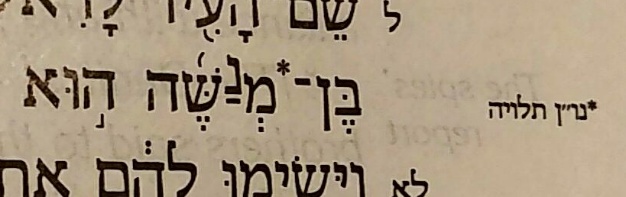
Figure - Manasseh with Raised Nun in Judges 18:30, Nosson Scherman et al., eds., The Stone Edition Tanach, 3rd ed., ArtScroll series (Brooklyn, NY: Mesorah Publications, 2013), 632.
- Judges 20:13 – The Masoretic Text says, “Benjamin were not willing,” a grammatical mistake involving a plural verb and a singular subject. Instead, the Septuagint, Syriac, and Targum versions of this verse have, “The sons of Benjamin were not willing.” The scribe for the Hebrew manuscripts most likely saw the Hebrew בני בנימן and accidentally forgot to write the word “sons of” (בני) because the next word (בנימן) started with the same letters. All subsequent scribes in the Masoretic family of manuscripts then recopied this scribal mistake.
- 1 Samuel 13:1–2 – The Masoretic manuscripts have an incomplete year “formula” that makes Saul king when he is only one year old, and reigning for only two years, even though this conflicts with 1 Samuel’s timeline of Saul’s reign. Saul was not an infant king. Some Greek manuscripts give Saul’s age as 30 years old at the beginning of his reign, and the Syriac gives his age as 21. Unfortunately, the original number may have been lost.
These few examples are small and relatively insignificant textual variants. For every variant in the Masoretic Text, there are hundreds of verses that are unquestioned and sure. The Hebrew of the Masoretic Text is remarkably intact and trustworthy, and textual criticism rarely affects meaning, teaching, or practice.
However, these minor discrepancies remain problematic; they are still imperfections in our manuscripts. All it takes is one imperfection to make the manuscript less than perfect. A better methodology, grounded in the manuscripts themselves, is to compare the various Hebrew manuscripts against each other and to ancient translations and attempt to piece together the most accurate text. That is what the science of textual criticism is all about, and the sages have practiced this science since at least the time of the Talmud Yerushalmi.
If textual criticism was only relevant in deciding between Rodanim and Dodanim, or Manasseh and Moses, then it might be of interest only to a niche field of scholars. However, when it comes to questions about Yeshua being the Messiah, textual criticism is much more than a curiosity for academics. Some of the most controversial passages in the Tanakh in Jewish-Christian conversations are related to textual issues. For example,
- Did David, the forerunner of the Messiah, say, “They pierced my hands and my feet” in Psalm 22:16?
- Did Hosea say, “Instead of bulls we will repay the offering of our lips” in Hosea 14:2, teaching that prayer can substitute as sacrifice?
- Did David say, “A body you have prepared for me” in Psalm 40:6 (Hebrew, v.7)?
Each of these are questions about textual criticism before they are questions of interpretation. If we do not give textual criticism a place in the discussion, then we are missing an essential ingredient. Before determining what a text means, we must ensure we are looking at the right text.
4. The Chosen People Answers Position: Textual Variants Don’t Diminish the God-Given Original Manuscripts of the Bible
Some people feel like the world is collapsing when exposed to textual criticism because they can no longer trust the Bible. They have been told their whole lives, “The Bible is perfect. The Bible is holy,” and they conclude that the Bible cannot be true if there are imperfections in the text. No longer can the Bible be God’s word, and no longer can Moses be the one who received the Torah. If there are mistakes, then the Scriptures must have been written by man alone, and Judaism and Christianity are built upon shoddy foundations.
But this is not at all what we are advocating. A radical loss of faith should not be the necessary consequence of admitting that there are textual differences in today’s Hebrew manuscripts. Instead, we at Chosen People Answers fully affirm the following statement by Rabbi Josh Yuter:
God gave a Torah to Moses, and this Torah was completely divine in its transmission even though our physical Torah scroll may have undergone some changes over time.[20]
To put it in our own words, we believe fully in the divine origin of the Torah, the Writings, and the Prophets. These were not books that were created in the mind of men alone. They are holy writings that were inspired by God himself. We believe that they were given to men by God without error—they were inerrant. When the authors of these books took their pens to the manuscripts, their words were entirely perfect, holy, without error, and wholly the word of God. That original manuscript is called the “autograph,” since it is the one that was written by the author. Eventually, the autographs of the biblical books were compiled by divinely inspired editors into the final form of the books we have in the Tanakh. We are attempting to reconstruct these final forms in textual criticism.[21]
However, these final forms were eventually copied and made into daughter and granddaughter manuscripts, but with each one of those copies, some inadvertent or (God forbid) intentional changes were made. They deviated from the original. These changes were not “inspired by God” like the initial version.[22] There were mistakes that sadly were sometimes copied and recopied to the point that the mistakes look like the correct version. Unfortunately, like most writings from antiquity, we do not have any original autographs or final manuscripts available, so we rely upon daughter manuscripts that may have minor mistakes within them.
Consequently, at Chosen People Answers, we begin with the assumption that no biblical manuscript is free of error, but that we should use all biblical manuscripts currently available to attempt a reconstruction of what the final version of a text originally said. This process of textual criticism is science melded with faith: we seek a justifiable methodology to establish a trustworthy text so that we may better follow it and the Divine Author who inspired it. Consequently, to the best of our understanding, the original wording as penned by the original authors is the infallible revelation from God, fully deserving of our faith and devotion.
Although we believe that the Leningrad Codex, which is the basis of most Jewish and Christian Bibles, is our most trustworthy manuscript of the Hebrew Bible, we do not believe it is perfect. There are other manuscripts that may preserve readings that are more original than the Leningrad Codex. Every ancient version of the Hebrew Bible should be allowed to speak, although not all versions are equally valuable. The Israeli textual scholar Emanuel Tov explains the need for examining all biblical sources:
Since no single textual source contains what could be called the biblical text, a serious involvement in biblical studies necessitates the study of all sources, which necessarily involves study of the differences between them. The comparison and analysis of these textual differences thus holds a central place within textual criticism.[23]
We believe our posture toward textual differences is the most credible one that allows for the divine authority of the text of Scripture while honestly dealing with the variations we see in the manuscripts. We are unwilling to turn our backs on the divine authority of the text by saying that it is a human fabrication. Yet, we are also unwilling to stay blind to the manuscript variations. Our position given above enables us to find a middle route that marries faith with evidence. And, apart from a few controversial cases, in most situations the manuscript differences affect no significant doctrine or practice.
5. Conclusion: Textual Criticism Enables a More Reasonable Faith
If someone were to recite Maimonides’ eighth principle three times a day and never compare two Hebrew manuscripts with each other, we would understand why the topic of this article could be unsettling. However, the evidence doesn’t lie, and many rabbinic authorities have recognized the problems we have highlighted here.
All we need to be ready to do is to follow the evidence and concede that some passages have discrepancies due to the copying process. Once we come to that conclusion, we must be prepared to jettison any interpretation, tradition, and effect of the incorrect version, and replace it with the correct text. There are passages in the Masoretic Text that deserve a second look. A good place to start is our Textual Criticism 101 article. We encourage you to consider the evidence and go where it leads.
6. Bibliography
Albo, Rabbi Joseph. Sefer Ha-Ikkarim. Philadelphia, PA: Jewish Publication Society of America, 1929.
Angel, Marc D. Maimonides’ Essential Teachings on Jewish Faith and Ethics: The Book of Knowledge and the Thirteen Principles of Faith : Selections Annotated and Explained. Woodstock, VT: SkyLight Paths, 2012.
Kennicott, Benjamin. Vetus Testamentum Hebraicum : cum variis lectionibus. Vol. 2. Oxonii : Typographeo Clarendoniana, 1776. Accessed January 23, 2021. http://archive.org/details/vetustestamentum02kenn.
Maimonides, Moses. פרקי אבות: Including Shemoneh Perakim, the Rambam’s Classic Work of Ethics and Maimonides’ Introduction to Perek Chelek Which Contains His 13 Principles of Faith. Translated by Eliyahu Touger. Brooklyn, NY: Moznaim Publishing Corporation, 1994.
Neusner, Jacob. The Jerusalem Talmud: A Translation and Commentary. Peabody, Massachusetts: Hendrickson, 2008.
Scherman, Nosson. The Chumash: The Torah: Haftaros and Five Megillos with a Commentary Anthologized from the Rabbinic Writings. Edited by Hersh Goldwurm, Avie Gold, and Meir Zlotowitz. 11th ed. Brooklyn, NY: Mesorah Publications Ltd., 2013.
Scherman, Nosson, Yaakov Blinder, Avie Gold, and Meir Zlotowitz, eds. The Stone Edition Tanach. 3rd ed. ArtScroll series. Brooklyn, NY: Mesorah Publications, 2013.
Shapiro, Marc B. The Limits of Orthodox Theology: Maimonides’ Thirteen Principles Reappraised. Portland, OR: Littman Library of Jewish Civilization, 2004.
Yuter, Josh. “Biblical Criticism for the Shomer Torah.” YUTOPIA, July 24, 2013. Accessed November 29, 2022. https://joshyuter.com/2013/07/24/random-acts-of-scholarship/biblical-criticism-for-the-shomer-torah/.
“The 13 Principles of the Jewish Faith.” Chabad of Israel. Accessed November 29, 2022. http://www.chabad.org.il/Articles/Article.asp?ArticleID=1955&CategoryID=150.