The Ethics of the Apostles
Encounter the teachings of Yeshua and his disciples through a familiar style.
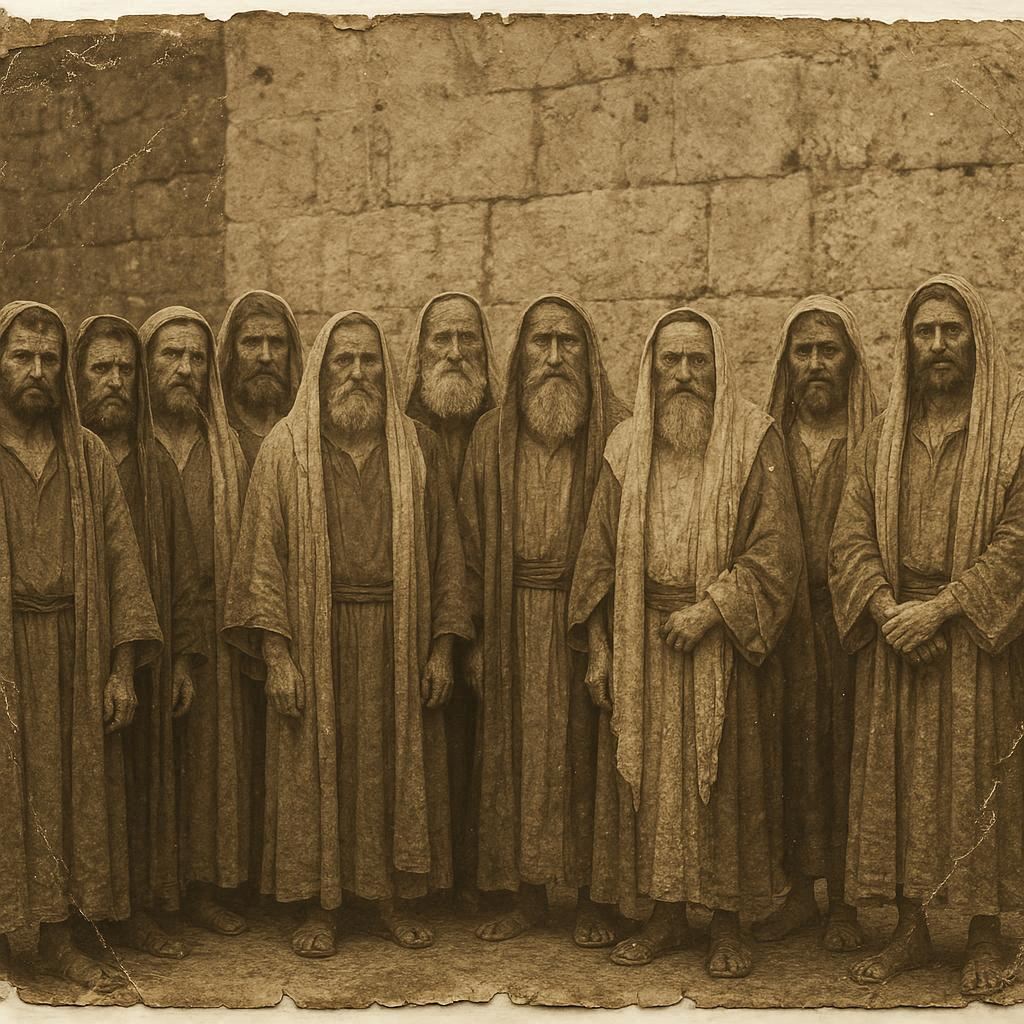
1. Pirke Shlichim
Moses received Torah at Sinai and handed it on to Joshua, Joshua to elders, and elders to judges.[1] And the Torah was forgotten by Israel and restored by Josiah.[2] The Torah went out to the people, and the prophets called upon the people to follow. The Torah was forgotten and all Israel went into exile to Babylon. The Torah was restored by Ezra, and it was handed to the men of the great assembly.[3] They said three things: “Be prudent in judgment. Raise up many disciples. Make a fence for the Torah.”[4]
The men of the great assembly handed the Torah to the Cohanim, Perushim, and Tzaddukim. Simeon the Righteous lived in their days. The Ruach haKodesh rested upon him, and he said, “A child is appointed for the fall and rise of many in Israel, and for a sign to be opposed, so that the thoughts of many hearts may be revealed.”[5]
R. Yeshua of Natzaret lived in the days of the Perushim and Tzaddukim. He would say, “For I say to you that unless your righteousness surpasses that of the scribes and Perushim, you will not enter the kingdom of heaven.”[6]
R. Yeshua would say, “Do not think that I came to abolish the Torah or the Prophets; I did not come to abolish but to fulfill.”[7] One of the scribes approached R. Yeshua and asked, “Which mitzvah is the most important of all?” R. Yeshua answered, “The most important is, ‘Hear, O Israel: The Lord our God, the Lord is one. And you shall love the Lord your God with all your heart and with all your soul and with all your mind and with all your strength.’[8] The second is this: ‘You shall love your neighbor as yourself.’[9] There is no other mitzvah greater than these.”[10]
R. Yeshua would say, “Blessed are the poor in spirit, for theirs is the kingdom of heaven. Blessed are the pure in heart, for they shall see God.[11] Do not store up for yourselves treasures on earth, where moth and rust destroy, and where thieves break in and steal. But store up for yourselves treasures in heaven, where neither moth nor rust destroys, and where thieves do not break in or steal; for where your treasure is, there your heart will be also.[12] It is out of the overflow of the heart the mouth speaks.[13] But I say to you that everyone who is angry with his brother shall be guilty before the court; and whoever says to his brother, ‘You good-for-nothing,’ shall be guilty before the Sanhedrin; and whoever says, ‘You fool,’ shall be guilty enough to go into the fiery hell.[14] But I say to you, love your enemies and pray for those who persecute you.[15] If you greet only your brothers, what more are you doing than others? Do not even the Gentiles do the same? Therefore you are to be perfect, as your heavenly Father is perfect.”[16]
R. Shimon b. Yonah received the semikhah from R. Yeshua. He would say, “Honor all people, love the brotherhood, fear God, honor the king.”[17] He said, “Be harmonious, sympathetic, brotherly, kindhearted, and humble in spirit; not returning evil for evil or insult for insult, but giving a blessing instead; for you were called for the very purpose that you might inherit a blessing.”[18] To the Perushim and Tzaddukim, he said, “We must obey God rather than men.”[19]
R. Yohanan b. Zechariah received the semikhah from R. Yeshua. He would say, “Do not love the world nor the things in the world. If anyone loves the world, the love of the Father is not in him. For all that is in the world, the lust of the flesh and the lust of the eyes and the boastful pride of life, is not from the Father, but is from the world.[20] But the one who hates his brother is in the darkness and walks in the darkness, and does not know where he is going because the darkness has blinded his eyes.[21] Beloved, let us love one another, for love is from God; and everyone who loves is born of God and knows God. The one who does not love does not know God, for God is love. By this the love of God was manifested in us, that God has sent His only begotten Son into the world so that we might live through Him.”[22]
This word he received from R. Yeshua, who said, “In everything, therefore, treat people the same way you want them to treat you, for this is the Torah and the Prophets.”[23]
R. Shaul of Tarsus received the semikhah from R. Yeshua. He says, “The Torah is holy, righteous, and good. Yet no one is made righteous by Torah.”[24] He would say, “There will be tribulation and distress for every soul of man who does evil, of the Jew first and also of the Greek, but glory and honor and peace to everyone who does good, to the Jew first and also to the Greek. For there is no partiality with God.[25] Render to all what is due them: tax to whom tax is due; custom to whom custom; fear to whom fear; honor to whom honor. Owe nothing to anyone except to love one another; for he who loves his neighbor has fulfilled the Torah.”[26]
He also said, “Do you not know that those who run in a race all run, but only one receives the prize? Run in such a way that you may win. Everyone who competes in the games exercises self-control in all things. They then do it to receive a perishable wreath, but we an imperishable. Therefore I run in such a way, but not aimlessly; I box in such a way, but not beating the air; but I discipline my body and make it my slave, so that, after I have preached to others, I myself will not be disqualified.”[27]
R. Shaul said, “We exult in our tribulations, knowing that tribulation brings about perseverance; and perseverance, proven character; and proven character, hope; and hope does not disappoint, because the love of God has been poured out within our hearts through the Ruach HaKodesh who was given to us.[28] Who will separate us from the love of Messiah? Will tribulation, or distress, or persecution, or famine, or nakedness, or peril, or sword?[29] For I am convinced that neither death, nor life, nor angels, nor principalities, nor things present, nor things to come, nor powers, 39 nor height, nor depth, nor any other created thing, will be able to separate us from the love of God, which is in Messiah Yeshua our Lord.”[30]
R. Yaakov b. Yosef received the semikhah from R. Yeshua, his brother. He said, “Do not show personal favoritism, bridle the tongue, and do not boast about tomorrow.” He said, “Where jealousy and selfish ambition exist, there are disorder and every evil thing.”[31] He would say, “Consider it all joy, my brethren, when you encounter various trials, knowing that the testing of your faith produces endurance. And let endurance have its perfect result, so that you may be perfect and complete, lacking in nothing. But if any of you lacks wisdom, let him ask of God, who gives to all generously and without reproach, and it will be given to him.[32]
To his talmidim, he taught, “Let not many of you become rabbonim, my brethren, knowing that as such we will incur a stricter judgment. For we all stumble in many ways.”[35]
R. Yeshua would say, “Truly, truly, I say to you, unless one is born again he cannot see the kingdom of God.”[36]
He said, “For God so loved the world, that He gave His only begotten Son, that whoever believes in Him shall not perish, but have eternal life. For God did not send the Son into the world to judge the world, but that the world might be saved through Him.”[37] He said, “Ask, and it will be given to you; seek, and you will find; knock, and it will be opened to you.”[38]
R. Yohanan b. Zechariah says, “The world does not have space to contain the books that could be written about the words and deeds of Yeshua.”[39]