Is the New Testament Filled With Contradictions?
Learn how to deal with alleged contradictions in the New Testament through fourteen principles and strategies... that work with alleged contradictions in the Hebrew Scriptures too!

The stories told in the New Testament, and the passion narratives in particular, are so inconsistent that the resurrection story collapses under careful scrutiny. The conflicting testimonies of the evangelists are so unreliable that they would not stand up to critical cross-examination in any court of law. In fact, there is virtually not one detail of the crucifixion and resurrection narratives upon which all four Gospel authors agree.[1]
—Rabbi Tovia Singer, Let’s Get Biblical
Because the New Testament has been scrutinized with more intensity than any other work of literature in the history of the world, it is not surprising to discover that virtually every passage in the Gospels has been seen as conflicting with some other passage by someone or other at some time in history…. Most of the charges have been answered adequately many times over by those who have written in defence of the Gospels’ trustworthiness or just in the course of detailed commentary-writing.[2]
—Craig Blomberg, The Historical Reliability of the Gospels
1. Introduction: Applying Equal Weights and Measures to New Testament Contradictions
Years ago, I was introduced to a man who grew up in a Christian context but later converted to Orthodox Judaism as an adult. I will call him Michael. He and I met two weeks in a row to discuss matters of history and faith. He shared his conversion story and said the turning point in his faith involved taking a course at a Christian college where he compared the four New Testament Gospels—Matthew, Mark, Luke and John—in order to illustrate how they are a cohesive whole. It did not turn out as he had expected.
Michael recounted, “The last thing I did as a believer [in Jesus] was when I studied the four Gospel accounts. I took a class early in my studies called ‘Harmony of the Gospels.’ A lot of it was about fitting the puzzle pieces [of the Gospels together]. I did what someone recommended: I made four columns and I started with Passion week on down to the Ascension and put together all the major pieces of the puzzle. I tried to make a seamless whole. It wouldn’t fit together . . . there were at least fifty disconnects in there.”
This was the decisive moment when Michael lost his trust in the New Testament and, by extension, his faith in Jesus. Within a few years, Michael decided to turn to Orthodox Judaism.
After this initial encounter where he shared his story, we met together the following week, and I came prepared with a single sheet of paper entitled, “Synoptic Problems in the Tanakh.”[3] On each side of the paper, I placed multiple columns, and within the columns I listed parallel accounts of passages from the Hebrew Bible. My purpose for giving Michael this table was not to destroy his faith in the Hebrew Scriptures. Rather, it was to undermine his reasons for rejecting the New Testament. The table was as follows:
Table - Synoptic Problems in the Tanakh
The Problem | Text A | Texts B / C / D |
Who changed Jacob’s name? | A man (אִישׁ), and God (אֱלֹהִים) | God (אֱלֹהִים) Hashem (יהוה) Hashem, an Angel (מַלְאָךְ), and God |
Remember or Observe? | “Remember the sabbath day and keep it holy.” | “Observe the sabbath day and keep it holy, as the Lord your God has commanded you.” |
Dodanim or Rodanim? | Dodanim (majority of manuscripts) Rodanim (minority of manuscripts, LXX, and Sam. Pent.) | Rodanim (majority of manuscripts, LXX) Dodanim (minority of manuscripts, Syriac, Vulgate) |
Did 2 Samuel censor the list of instruments, or did 1 Chronicles invent a list of new ones? | 2 Sam. 6:15 Thus David and all the House of Israel brought up the Ark of the Lord with shouts and with blasts of the horn. | 1 Chr. 15:28 All Israel brought up the Ark of the Covenant of the Lord with shouts and with blasts of the horn, with trumpets and cymbals, playing on harps and lyres. |
What did David actually pray? | מַה־יֹּוסִיף עֹוד דָּוִ֛יד אֵלֶיךָ לְכָבֹוד אֶת־עַבְדֶּךָ וְאַתָּה אֶת־עַבְדְּךָ יָדָעְתָּ׃ יְהוָה בַּעֲבוּר עַבְדְּךָ וּכְלִבְּךָ עָשִׂיתָ אֵת כָּל־הַגְּדוּלָּה הַזֹּאת לְהֹדִיעַ אֶת־כָּל־הַגְּדֻלֹּות ׃ | |
Did Hashem or Satan incite David to conduct the census? | “The anger of the Lord again flared up against Israel; and He incited David against them, saying, ‘Go and number Israel and Judah.’” | “Satan arose against Israel and incited David to number Israel.” |
After placing this table in Michael’s hand, I asked, “Should you leave Orthodoxy now?” My point was that if contradictions between the Gospel accounts means they are untrustworthy, then contradictions between passages in the Hebrew Scriptures means these texts are also untrustworthy; and therefore if Michael left his faith in Jesus based on the apparent contradictions in the New Testament, then he should not remain an Orthodox Jew either based on similar assumptions. Michael understood the argument I was making. He quipped, “No, I should become a pagan.”
I wanted him to recognize the following: The same strategies that resolve apparent contradictions in the Hebrew Scriptures can resolve apparent contradictions in the New Testament. If we use equal weights and measures (Deut 25:13–15) and apply reasonable interpretation strategies equally to the Hebrew Scriptures and the New Testament, then we may see that supposed contradictions in the New Testament are not truly contradictions.
This article will demonstrate multiple reasonable strategies for resolving discrepancies in the Hebrew Bible and the New Testament, including:
- Consulting biblical commentaries
- Avoiding arguments based on half-truths
- Allowing for differences in rhetorical precision
- Avoiding anachronistic reasoning
- Applying reasonable procedures to tricky discrepancies, including those related to emphasis and omission, narrative compression, narrative sequence, speeches, and textual criticism.
These strategies will be employed profitably to solve the supposed Tanakh contradictions I placed on the handout for Michael—and will likewise be used for similar issues in the New Testament. In so doing, I will illustrate that belief in the New Testament’s accuracy does not conflict with being logical, reasonable, or intelligent.
On the contrary, the detractors of the New Testament that are best known for crying “Contradiction!” are the ones who illustrate lazy and faulty reasoning in these matters because they ignore the principles we will discuss.[4] This article will interact with the criticisms of the following three Jewish authors who have published works concerning supposed contradictions in the New Testament:
- Isaac of Troki, the sixteenth-century Karaite author of the influential book, Faith Strengthened (Chizzuk Emunah). [5] Although Troki was a Karaite (he rejected rabbinic authority), his book continues to inspire and provide arguments for Orthodox detractors of the New Testament, so his methodology and ideas are still relevant today.
- Asher Norman, a contemporary Jewish critic of the New Testament and author of Twenty-Six Reasons Why Jews Don’t Believe in Jesus.[6]
- Rabbi Tovia Singer, a prolific speaker and author of books such as Let’s Get Biblical, where he claims to identify New Testament contradictions.[7]
As we consider ways to identify and disqualify claims of contradictions, these authors will provide many examples of faulty reasoning to avoid. Contrary to their claims, there are good reasons to believe that the New Testament does not contain errors or contradictions, as we will show.
Unfortunately, Michael never provided me with solutions to the supposed contradictions in the Tanakh. After receiving my handout with the columns, he requested time to consider the matter. Despite my best attempts to meet up again, that time never came. This article includes many principles and methodologies for resolving contradictions that I wish I could have given Michael if he had allowed me the chance.
2. Steps for Identifying Actual Contradictions and Eliminating Mistakenly Identified Ones
Identifying what is a logical contradiction and what is not lies at the heart of this topic, and such identification is not a simple affair. When considering the definition of a contradiction under formal logic, the answer is simple: a contradiction is when something is claimed to be both true and false at the same time and in the same way. However, transferring that concept to the realm of human communication is far more complicated. This section will introduce how to identify possible contradictions and filter out ones that are not truly contradictory.
2.1. Step 1: Start with the Laws of Logic
In the philosophical discipline of logic, there are three uncontestable laws about propositions (statements that claim to be true):
The law of identity: Something is what it is and not anything else.The law of noncontradiction: For any property F, nothing can be both F and not-F at the same time and in the same way.The law of the excluded middle: Any proposition is either true or false and not something in between.[8]
These are a priori laws, first discovered by Aristotle,[9] that need no evidence in their favor except that rational thought cannot proceed without them. Philosophers J.P. Moreland and Garrett DeWeese write concerning these laws, “They cannot be proved, but their truth is inescapable, for as soon as you try to disprove any one of them, you find you must assume it.”[10] Philosophers call inescapable laws of this sort, “first principles.”[11]
To identify a contradiction, we must first have the observational and reasoning skills to identify equivalencies (the law of identity). Some equivalencies are simple: I am equal to myself, my house is equal to my home, and my college sweetheart is equivalent to my wife.[12] However, for some claims of equivalence, a person needs to acquire skills to be able to verify their truth or falsehood. For example, the following mathematical formula claims to be a statement of truth:
10 + 6 * [2 * (16 – 4) + 8] = 28 – 7 * 23 + 2
Is this statement true? It takes some mental concentration and skill to be able to verify that, yes, the equation is true since each side equals 202. A person without such skill (or a calculator!) may be misled to believe that there is a contradiction between the two sides, when in fact there is not. The same could be said about someone who is impatient or who has more self-confidence than skill, keeping them from accurately considering both sides of the equation.
The second necessary skill for identifying a contradiction is demonstrating that two propositions (truth claims) cannot be true at the same time and in the same way (the law of noncontradiction). This is easy in mathematics once all terms have been simplified to their basic forms, such as 202=202. In this equation, both sides are in the same domain (whole numbers) with an equivalent magnitude. However, when we leave the realm of simple pre-calculus mathematics, such as comparing literary texts, identifying a contradiction becomes more complicated.
Finally, we must ensure that the propositions under consideration are wholly truthful, rather than only partially true. The law of the excluded middle states that a proposition that is only partially true ought to be treated as totally false when it comes to constructing arguments. Later, we will give examples of faulty arguments premised on half-truths.
2.2. Step 2: Define the Terms of the Propositions in Question
In order to identify a contradiction, it is first necessary to state the two propositions that are under investigation. Below are examples of pairs of propositions (truth claims):
Table - Pairs of Propositions
Contradictory Propositions | Non-Contradictory Propositions |
Ben is a bachelor | Ben was a bachelor |
Care must be taken when articulating propositions to provide terms written in unambiguous language that avoids unnecessary confusion. The need for unambiguous language is shown in the following geometry example:
B is a square
B is a rectangle
Is this a contradiction? While it may seem like one, it is not, because a square may be defined as a rectangle with equal-length sides. Thus, both propositions may be true about B at the same time and in the same way, even though different words are used to describe B. We can illustrate the compatibility between the two propositions by writing an expanded version:
B is a rectangle with four equivalent-length sides
B is a rectangle
Now, with these expanded terms, it can be clearly seen that Proposition 2 is consistent with Proposition 1.
This geometrical example shows the importance of this principle: Clearly define the terms of the propositions, necessitating accurate knowledge of the terms themselves and their potential overlap. If one cannot define “square” or “rectangle” with sufficient clarity, then a muddled analysis will follow. Many claims of logical contradictions fail because the one doing the analysis has poorly defined the terms of the propositions in question.
2.3. Step 3: Self-Assess Whether You Have Considered All Reasonable Possibilities
The most difficult step in identifying true contradictions is to evaluate one’s own contradiction-finding ability through a methodical process. All too often, those who are quick to claim contradictions have an over-inflated opinion of their abilities and an underdeveloped skillset applicable to the task.
It is easy to claim that two propositions are contradictory, but there is a very high bar that two propositions must pass before they can be identified as claiming two mutually exclusive things at the same time and in the same way. If the terms involved in the propositions are unambiguous, comprehensive, and simple, then identifying a real contradiction can be quick and intuitive. For example, a bachelor cannot be married. However, for more complex propositions—including those involving history, culture, different languages, or rhetorical devices—we cannot skip to the conclusion of “contradiction” through mere intuition. We need more exploration to be considered credible judges of these matters.
To guard against falsely identifying contradictions, I propose a filter or checklist by which claims of textual contradictions may be judged. There are a variety of principles to apply to situations where contradictions are suspected. The following principles should provide a good starting point for assessing one’s intuitions about contradictions, but the reader is encouraged to consider other authors’ handling of the subject as well.[13]
In our third step for identifying contradictions in texts, we proposed a kind of filter by which claims of contradictions may be judged as accurate or misleading. The principles listed below are not exhaustive, and consulting other authors’ works is recommended.[14] However, as we will see for the remainder of this article, the following principles provide an effective filter that disqualifies many, if not most, accusations of contradictions in the New Testament and Hebrew Scriptures.
3. Principle #1: Avoid a Prejudicial Attitude
It is appropriate to address the interpreter's biases before we address topics relating to specific factual issues independent of the interpreter.
Many interpreters come to the New Testament with an attitude of suspicion. In their mind, the New Testament is guilty before being proven innocent, if its innocence is even permitted. Although both Jewish and Gentile readers can come to the New Testament with an attitude of suspicion, because of historical Christian antisemitism, this is often an acute problem for Jewish readers. As we have documented elsewhere, many Jewish people have been taught that the New Testament is dangerous, antisemitic, off-limits for Jews to read, or a book that represents another religion. Understandably, for these Jewish people, their preconceived attitude about the New Testament tends to make any criticism of the New Testament feel right, and any defense of it feel wrong. This, in turn, encourages Jewish people to take intellectual shortcuts through unsympathetic or uninformed readings of New Testament texts, thereby resulting in many claims of internal contradictions in the New Testament. Others may not even open a New Testament, but believe the claims of others that it consists of contradictions, fables, and that it is a non-Jewish book.
This kind of unsympathetic attitude is not only a Jewish phenomenon. Anyone can fall into this trap with a text they are predisposed to dislike. For example, many Jewish people would protest if a hostile Gentile were to read the Babylonian Talmud with a condemning, critical spirit, devoid of respect for the sages and quick to highlight unsavory bits of halakhic disputes. Such an interpreter should not be called credible or a Talmud scholar by any means. The same attitude ought to be avoided when approaching the New Testament.
“The hermeneutics of suspicion”—the unsympathetic study of a text for criticism—biases the interpreter against seeing possible ways to lessen the suspicion. While there could be reasonable ways to address their complaints, a suspicious person often refuses to be skeptical of their own skepticism. Such an interpreter needs to learn to recognize his or her own biases and give credit where credit is due, which are basic tenets of intellectual honesty and humility.
When addressing how to deal with difficulties in both the New Testament and Hebrew Scriptures, the twentieth-century revivalist R.A. Torrey encouraged his readers to proceed honestly, humbly, determinedly, fearlessly, patiently, scripturally, and prayerfully.[15] Fruitful study of this topic can only proceed if these set of attitudes are pursued.
4. Principle #2: Consult Commentaries and Reputable Scholars
The Hebrew Bible and the New Testament are among the most studied texts in existence, beloved for millennia and read by billions. When reading such historic documents, we would be wise to read them while conversing with the best and the brightest commentators who have gone before us or are still with us today. It would be a mistake to assume that one could accurately criticize such monumental works while reading them in isolation.
This principle is self-evident in Orthodox Jewish circles when it comes to the Tanakh or Talmud. If there is an apparent contradiction between two texts, an Orthodox reader is encouraged to consult Rashi and the other Rishonim, to look for the passage(s) in the Gemara, and to see if respected Sages have already resolved the discrepancy. The reader should not rely on himself or herself as the sole authority capable of adjudicating claims of contradictions.
The same principle should apply to the New Testament. It has been read, studied, picked apart, and discussed from countless angles for nearly two millennia. If we were to limit ourselves only to the apostolic fathers (first-second centuries CE) and Greek and Latin church fathers (second-fifth centuries CE), we would already find countless numbers of commentaries and discussions about every verse of the New Testament.[16] Of course, the study of the New Testament continued in the centuries beyond, and today there are libraries full of comprehensive multi-volume academic commentaries on the New Testament.[17] For example, one website catalogs more than 200 published commentaries on the Book of Matthew in English since 1970.[18] Beyond commentaries, many books on the market focus on addressing supposed contradictions in the New Testament.[19]
Because the New Testament has been studied with such intensity for millennia, it is highly unlikely that one will find a possible contradiction in the New Testament that has yet to be discussed at length somewhere in the available literature. It would be ridiculous to conclude that the New Testament is hopelessly contradictory before consulting published academic works that discuss such apparent contradictions.
Unfortunately, the two contemporary critics we are discussing make this very mistake. During his nearly forty-page handling of supposed contradictions in the New Testament, Asher Norman never once cites a published New Testament commentary.[20] New Testament commentaries are also missing from his book’s bibliography.[21] Tovia Singer’s handling of nineteen supposed contradictions is given in abbreviated table format, without citing any New Testament commentaries.[22] Singer’s two volumes of Let’s Get Biblical include no bibliographies, thus his use of sources is obscure.[23] By neglecting any interaction with contemporary or historical New Testament commentaries regarding supposed contradictions, Norman and Singer portray their reasoning as self-evident, expert-level, and without possible refutation.
The Torah requires using equal measures in judgment (Deuteronomy 25:13–15). What if Norman and Singer’s methodology were to be used on the Talmud? Many antisemitic critics of the Talmud choose to criticize the sages publicly without considering later commentaries on the Talmud, without considering halakhic codes, without speaking to contemporary Jewish scholars, instead relying on their individual reasoning. It is likely that Norman and Singer would call such a person arrogant, ignorant, and incapable of producing credible criticism of the Talmud.
Norman and Singer’s lack of consultation with historical or scholarly commentaries on the New Testament is illustrative of their considerable anti-New Testament bias and incomplete handling of the subject. An unaware audience may be led to believe that Norman and Singer are experts in the New Testament, but this trust is gained by leaving real New Testament scholars unmentioned. In this way, Norman and Singer take advantage of the trust and ignorance of their audience.[24]
Beyond verse-by-verse biblical commentaries, many authors have provided comprehensive works that address accusations of contradictions in the New Testament, and they often help to address passages cited by Troki, Norman, and Singer. Highly recommended responses to contradiction claims include:
- The Holman Apologetics Commentary on the Bible: The Gospels and Acts, edited by Jeremy Royal Howard[25]
- New International Encyclopedia of Bible Difficulties, by Gleason Archer[26]
- The Big Book of Bible Difficulties, by Norman L. Geisler and Thomas Howe[27]
- Answering Jewish Objections to Jesus, Volume 4: New Testament Objections, by Michael L. Brown[28]
Many additional resources are helpful as well, so the attentive reader should pay attention to the footnotes and bibliography accompanying this article.[29]
5. Principle #3: Many Contradiction Claims Are Due to Deficient Thinking
Oftentimes, when someone claims there is a contradiction between two biblical passages, the contradiction can only be attributed to the person’s faulty reasoning processes or ignorance. Some faulty approaches that contribute to faulty contradiction-finding include:
- Ignorance of historical context
- Ignorance of rhetorical devices
- Ignorance of proper hermeneutics
- Faulty premises
- Circular reasoning
- Mistaking correlation for causation
- Arguments from silence
There are many more kinds of mistakes like this which logicians call informal logical fallacies.[30] This article includes several principles and discussions concerning how to avoid these kinds of pitfalls.
6. Principle #4: Some Contradiction Claims Are Resolved by Pointing Out Half-Truths
Sometimes, truth claims are true in a particular realm, at a particular time, with a particular nuance, but are false when those qualifications are ignored. Consider the following propositions:
- Killing a human being is a capital offense in Torah (Genesis 9:6; Exodus 20:13).
- A man killed a thief who had broken into his house.
- Therefore, the man deserves the death penalty for killing the thief.
This appears to be an accurate argument: the conclusion follows if Propositions 1 and 2 are true. However, its conclusion is false, because Proposition 1 is a half-truth that is overstated. The Torah gives detailed stipulations about what does and does not fall under the first proposition as punishable for killing. Premeditated murder (killing “with a high hand”) is distinguished from manslaughter, and the latter does not deserve the death penalty. Moreover, killing in self-defense does not incur any guilt. The exact scenario of Proposition 2 is given as an exception to the general rule about murder (Exodus 22:2). Killing in self-defense is not to be seen as murder according to Torah. Rashi commented, “Here Torah teaches you: If someone is coming to kill you, kill him first. And this thief is coming to kill you.”[31] Thus, what appeared to be a true argument is not, since we were initially misled into thinking that the first proposition had a wider scope than the Torah stipulates.
Likewise, some interpreters employ half-truths when considering supposed contradictions in the New Testament. Such arguments are invalid, as we will show with examples in both the Hebrew Bible and the New Testament.
6.1. Hebrew Bible Example: Who Led David to Conduct a Census?
Parallel Passages: 2 Samuel 24:1 vs. 1 Chronicles 21:1
Both passages in question say that David conducted a census of Israel, but they identify different actors who influenced him to do so. Second Samuel says that “the Lord” (Hashem) incited David to conduct the census. First Chronicles says that Satan incited David to do so. Both passages agree that David sinned against the Lord by performing the census (2 Samuel 24:10, 1 Chronicles 21:7–8). The supposed contradiction thus comes down to who led David to sin in this way.
In considering this inconsistency, it would be a mistake to say that the only options would be that Hashem (only) incited David or that Satan (only) incited David. To give those as the only options would be to limit ourselves to half-truths. The Scriptures teach us about Satan, the Lord, and the relationship between them—all of which should have bearing on this supposed contradiction. When we allow Scripture to inform our understanding of the subjects involved, we find that there is no actual contradiction.
Early Jewish interpreters of these two passages recognized a theological solution that is followed by untold numbers of Jews and Christians still to this day.[32] The solution is implicit in Scripture, but made explicit in the ancient Targum Chronicles, which was probably produced in Judea before the fourth century CE. Recognizing how the Scriptures place Satan in a subservient role under God, the Targum solved the problem like this: “The Lord raised up Satan against Israel and he incited David to number Israel.”[33]
By adding the words “The Lord raised up” to the text of 1 Chronicles, the Targum provides a theological solution to the contradiction that illustrates how both passages can be true at the same time. Yes, the Lord incited David to conduct a census (per 2 Samuel), but he did so through Satan (per 1 Chronicles) as an intermediary.
This harmonization is consistent with other passages in Scripture that teach that the Lord is “king over all gods” (Psalm 95:3) and is the Most High God who is exalted above all gods (Psalm 97:9). The gods being referred to are not actually divinities, but created angelic powers like Satan (Job 1:6). Consequently, the Lord reigns as king over Satan and can use him to accomplish his decrees. These two passages are contradictory when viewed in isolation, but not contradictory when viewed through a biblical worldview that considers the full range of biblical revelation on the topic.
6.2. New Testament Example: The Curse of Jeconiah as a Half-Truth
According to Matthew 1:11–12, Jesus was descended from Jeconiah, a king of Judah from Solomon’s line. To some, this is problematic because God cursed Jeconiah, saying that his sons would not sit on the throne of David (Jeremiah 22:30). Given what Jeremiah says, so the argument goes, Jesus would be disqualified from being the promised messianic Son of David.
The half-truth nature of this argument has received various solutions from Christian authors. Some have accepted the continuance of the curse but have excused Jesus from its effects through the virgin birth or other unconvincing means.[34] An unintended side-effect of accepting the continuance of the curse on Jeconiah’s line is the invalidation of Matthew’s genealogy for any relevance regarding Jesus’s messianic lineage.[35]
On the contrary, it is incorrect to assume that the curse uttered on Jeconiah in Jeremiah 22:30 continued until Jesus’s time. As Messianic Jewish scholar Michael Brown helpfully explains, the prophet Haggai revealed to one of Jeconiah’s descendants, Zerubbabel, that the curse had been reversed.[36] Previously, God had likened Jeconiah to a signet ring on God’s hand that he would tear off (Jer 22:24). Using that same motif with his grandson Zerubbabel, God said, “On that day, declares the Lord of hosts, I will take you, O Zerubbabel my servant, the son of Shealtiel, declares the Lord, and make you like a signet ring, for I have chosen you, declares the Lord of hosts” (Haggai 2:23). The signet ring that was removed was restored; thus, the curse on Jeconiah’s line ceased circa 500 BCE. In Pesikta de-Rab Kahana 24.11,[37] Rabbi Aha bar Abun bar Benjamin and Rabbi Abba bar Rabbi Papa came to the same conclusion that Haggai revealed that the curse had been reversed.[38]
Is it true that Jeconiah’s line was cursed? Yes. Would this have threatened the messianic status of any of his descendants? Yes. Is it true that the curse was still in effect after 500 BCE? No. Thus, the curse was irrelevant to Jesus’s status as Israel’s Messiah. Citing it as a contradiction is a misleading half-truth.
6.3. New Testament Example: Tovia Singer’s Criticism of Hebrews 9:22
When handling the topic of atonement, Tovia Singer places the following verses side-by-side, claiming that the New Testament book of Hebrews contradicts the Torah:
Table - Leviticus and Hebrews
“For the life of the flesh is in the blood, and I have given it for you on the altar to make atonement for your souls, for it is the blood that makes atonement by the life” (Leviticus 17:11). | “Indeed, under the law almost everything is purified with blood, and without the shedding of blood there is no forgiveness of sins” (Hebrews 9:22). |
Commenting on the verses, Singer writes,
The author of the Book of Hebrews manipulated and misquoted Leviticus 17:11 completely out of context in order to bolster the cardinal Christian doctrine that there can be no remission of sin without the shedding of blood. Why did the author of the epistle tamper with this passage in the Torah?[39]
Singer then proceeds for multiple pages to illustrate places where forgiveness was given in the Tanakh without any blood sacrifice offered on the sinner’s account. We do not deny the passages Singer brings up as examples of bloodless atonement. However, this argument is premised upon a half-truth, resulting in it being a misleading and false conclusion.
In his handling of the subject, Singer repeatedly quotes the second half of Hebrews 9:22, which states, “And without the shedding of blood there is no forgiveness of sins.” Although Singer quotes the first half of the verse in his table, he never again quotes the first half or considers how the first half of the verse modifies the second. Hebrews 9:22 has two clauses that are related to one another and are connected by an especially important word: “almost.”
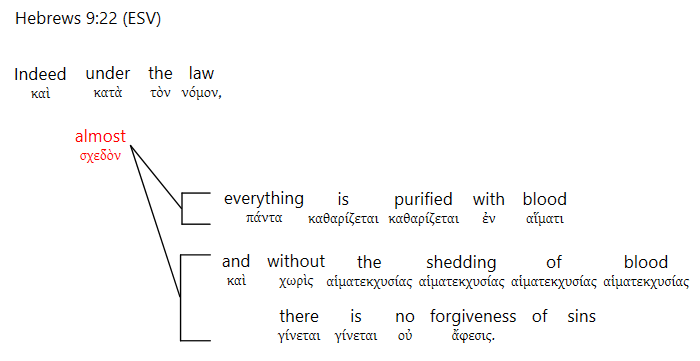
Figure - Hebrews 9:22 Exegetical Diagram
Hebrews is making a point that the default, widespread, almost-in-all-cases position of the Tanakh is that blood sacrifice is necessary for the forgiveness of sins. This is accurate. However, it is a misreading of the text to conclude that Hebrews says the exclusive way to forgiveness in the Tanakh was through blood sacrifice—because of that word “almost.” Yet, this is what Tovia Singer has done in his handling of the verse, creating a false contradiction on the premise of a half-truth that derives from a half-verse.
7. Principle #5: Understand the Difference Between Precision and Accuracy
There is a difference between being accurate and being precise, and any reliable analysis of contradictions must consider this nuance.[43] While the terms accurate and precise are related to each other, the former is tied to the notion of truth, whereas the second is not necessarily related to truth because it merely describes a statement’s level of specificity. Statements that are true match reality and are called accurate, whether they are precise (specific) or not; statements that are false do not match reality.[44] Thus, an accurate statement will always be true, but a precise statement can be false. For example, a proposition can be accurate without being precise, such as saying, “Some people in the world speak Hebrew.” Likewise, a proposition can be precise without being accurate, such as saying, “My dog Fido can bark the Shema in Hebrew in minor key.”
As an analogy, the truth could be likened to a target on a battlefield. A rocket launcher and a sniper rifle can each accurately hit the target, but the latter is much more precise in doing so, requiring greater skill to land a sniper shot. If a sniper shot misses the target, the bullet was precise (specified) in the location it hit without being accurate. In contrast, all one must do to hit a target with a rocket launcher is to hit the ground somewhere nearby. Just as with rocket launchers on the battlefield, imprecise linguistic statements have a vital role in human communication, and it would be irrational to expect all human language to communicate with the pinpoint precision of the sniper rifle.
For example, newly introduced people routinely ask each other, “Where did you grow up?” What is an appropriate level of precision for the response? Suppose one responds with, “At 4716 14th Avenue, fourth floor, apartment 4B. My room was the second bedroom to the right.” That may be a very precise statement, but it likely went far beyond the precision the other person wanted. It is also likely that the response’s precision got in the way of successful communication because it was assumed that the other person would know where 14th Avenue is. A less-precise answer would have been ideal if one wanted to communicate better: “I grew up in Brooklyn.” It may be better to be even more general in an international situation: “I grew up in the United States.” All three statements are accurate but have different levels of specificity (precision).
Here is another example. Let’s say that you are at a restaurant with friends when you receive a photo in a text message. You smile. Then your friends ask you what was in the message. You hold up your phone and say, “It’s a photo of Rebecca at the Mets game! She got tickets!” Then your overly precise friend pipes up, “Sure, Rebecca is in the photo, but that’s not all! I see roughly 400 people in the background of the photo, as well as the baseball diamond and many empty seats.” You think to yourself, Yes, okay, that may be true, but this is still a selfie of Rebecca at her first Mets game. Your statement and your friend’s statement were both true.
All the statements above about a childhood apartment and Rebecca’s photo may be accurate, but some are more precise than others. That’s okay! We need both general and precise statements to communicate well with each other. A proposition is accurate based on its relationship with truth, and a proposition is precise based on its level of specificity. This important principle will be illustrated in biblical texts in our subsequent sections.
8. Principle #6: Differences in Precision Do Not Necessarily Imply Inaccuracy
Multiple accounts of any event will always have differences in reported precision. Consider Rebecca at her Mets game. She might say, “There was a huge crowd at the Mets game!” Such a statement is grounded in Rebecca’s own experiential assessment of the size of the crowd, but “huge” has no precise definition. Another attendee might instead say, “I think there were roughly seventy thousand people at the game.” This statement is more precise than Rebecca’s assessment of “huge,” but it is still a round number estimate. If Mr. Spock from Star Trek had attended the Mets game, he might have been dissatisfied with both prior statements. The Vulcan might have proceeded to tally the exact number of visitors from a ticket sales database (67,293 tickets sold) before reporting. Are all three approaches accurate? Broadly speaking, yes, but some are more precise than others.
When confronted with an apparent contradiction between two or more accounts, we should ask ourselves whether the more precise account might be consistent with the more generalized one.[45] Is it possible that the less-precise statement points to the same truth as the more-precise statement? If so, then it is not a contradiction at all. Different accounts with different levels of precision can be equally accurate. When confronted with two propositions that have different levels of precision, look for possibilities of overlap before concluding there is a contradiction.
This principle about precision is important because several categories we will discuss below are examples of differences in precision. These include differences in emphases and omissions, narrative compression, sequences, and ambiguous pronouns.
8.1. Hebrew Bible Example: Precision Differences Regarding Saul’s Fate
Parallel Accounts: 1 Samuel 31:10 and 1 Chronicles 10:10
In the New Testament and the Hebrew Bible, we find these same factors of precision at play. Sometimes an event is narrated two or more times, and one retelling is more precise than another. That does not mean that one account is less accurate than the other.
After King Saul was killed, the Philistines put his armor and body on display. According to 1 Chronicles, the Philistines put his armor in the “house of their gods,” and they put Saul’s decapitated head in the “house of Dagon.” A modern reader may wonder about the precise location of those places. There were multiple houses of Dagon in ancient Philistia (1 Sam 5:1–2, Judges 16:21–23). Which one did they take Saul to? In 1 Chronicles, the imprecision of the language does not answer these questions.
However, a parallel account in 1 Samuel offers a more precise description. It says that Saul’s weapons (a term that includes his armor) were placed in the temple of Ashtaroth, and his body was hung from a wall in the town of Beit Shean.
Table - Where Saul's Body and Equipment Were Taken
Precise | Imprecise |
The temple of Ashtaroth (1 Samuel 31:10) | House of their gods (1 Chronicles 10:10) |
House of Dagon | Beit Shean |
Consequently, 1 Samuel is more precise by mentioning a specific temple (Ashtaroth) rather than a generic one (“house of their gods”) and is less precise by mentioning a general location (Beit Shean) rather than a specific place that could be in several locations (“House of Dagon”). Rather than being contradictory, these two accounts can be harmonized to develop a coherent narrative: Saul’s weapons were taken to a specific temple of Ashtaroth, and Saul’s head was placed in the specific House of Dagon that was in the town of Beit Shean.
9. Principle #7: Rethink Unclear Language Before Claiming Contradiction
A fallacy that ensnares many is the expectation that language works with similar precision and clarity as common mathematical reasoning. Mathematics is a highly precise language with its own domains of meaning (whole numbers, real numbers, imaginary numbers, etc.) and grammar (order of operations). However, the complexity of spoken human language exceeds that of mathematics. Spoken and written human language includes categories of homonyms, figures of speech, summaries, context-laden meaning, semantic range, cultural idiom, humor, sarcasm, translation nuances, genre differences, euphemisms, and ambiguous pronouns. The study of these factors in communication is called rhetoric, and mastering rhetoric is essential for discerning contradictions.
Mathematics tends to use numbers in equivalent ways throughout different equations. This only sometimes holds true in rhetoric. The following examples illustrate how equivalently worded sentences can lead to different meanings:
- “The farm was used to produce produce”: the first produce ≠ the second produce.
- “Let’s eat, Grandma” ≠ “Let’s eat Grandma.”
- “I like rock” muttered by a geologist ≠ “I like rock” muttered by a hard-rock musician.
None of these can be accurately understood through simple mathematical logic based on the use of words alone. Rather, one must consider many different rhetorical variables that combine to establish the meaning of the terms employed.
Rhetoric is the art of effective human communication, and the study of rhetoric is a basic skill for being able to discern contradictory statements. Because words, phrases, and even complete propositions can have different meanings based on various factors, establishing a proposition's meaning can take effort. If rhetorical analysis is neglected, then a faulty analysis of contradictions is bound to result.
The texts of the New Testament, written as they are in human language, sometimes exhibit rhetorical constructions that can give rise to multiple interpretations. If one interpretation of a rhetorical construction leads to a contradiction, and another does not, then the text itself does not necessarily contain a contradiction; only one of the interpretations does. Below we will discuss three New Testament passages where this principle proves helpful in addressing differences in the accounts.
9.1. Resolving Supposed Contradictions Related to Semantic Range
Many words have a range of meaning instead of simplistic singular definitions. Standard English dictionaries such as Webster’s Collegiate, and standard Greek and Hebrew lexicons, such as the BDAG and HALOT, each give multiple definitions of words that are dependent on context.[46] For example, HALOT gives eleven different senses of the Hebrew word בֵּן (ben) in the Tanakh,[47] and philosophers Craig and Moreland give five senses of the English word “is.”[48]
Care must be taken when interpreting texts to ensure a reasonable understanding of the sense of the words. The correct sense of a word is dependent on many factors, but the immediate surrounding context is most important. Sometimes the sense of a word is unclear; it could be one or another meaning, and each has their own strengths in their favor. However, if one of the senses contradicts other biblical passages or known facts, and the other sense does not, then it is preferable to choose the sense that does not entail any contradiction. For example, when interpreting, “Honor your father and your mother, that your days may be long (יַאֲרִכוּן) in the land…” (Exodus 20:12), it would be a mistake to conclude that “long” means that respectful children will find their days elongated to 26 hours a day. No other biblical text supports that understanding of the promise, and it is contradicted by scientific truth. Instead, the sense of the word refers to an increased number of days, rather than the hour-length of the days themselves.
Isaac of Troki did not consider the range of meaning when he criticized the virgin birth of Messiah by citing multiple passages where Yeshua is called Joseph’s son (Luke 2:33, 4:22, etc.). He cited the use of the word “son,” and concluded, “These passages afford a complete refutation of the doctrine of the miraculous conception of Jesus, and thereby undermined the groundwork of the Christian faith.”[49] Not so, if the word “son” was used in the sense of “adopted legal heir,” which is how the New Testament portrays Jesus’s relationship with Joseph, where it is said that he was “thought of” as Joseph’s son (Luke 3:23).[50] The use of the word “son” (בֵּן) to refer to adopted sons appears in the Tanakh in Psalm 2:7, and also with Naomi’s adopted grandson (through Levirate marriage) in Ruth 4:17 (also see בַּת in Esther 2:15). Likewise, “father” need not always refer to one’s biological father, such as when Moses and Isaiah called God their “father” (Deut 32:6; Isa 63:16). By not considering the semantic range of the words involved, Isaac of Troki wrongly constructed a contradiction.
9.2. The Gospels Example: Yeshua’s Crucifixion Date Resolved by Considering Semantic Range
Many people believe that the Synoptic Gospels (Matthew, Mark, Luke) disagree with the Gospel of John regarding the date of Jesus’s crucifixion. Supposedly, the Synoptics place the crucifixion on the day after the slaughtering of the lambs—Nisan 15—whereas John places the crucifixion at the same time as the slaughtering on Nisan 14. Asher Norman puts it this way:
John’s Gospel reports that the “last supper” and Jesus’ crucifixion occurred on the preparation day, the day before Passover, which is the fourteenth day of the Jewish month of Nissan. As a result, there is no Passover Seder in John’s version of events. The three synoptic Gospels claim that the “last supper” was the Passover Seder itself and that Jesus was crucified the next day on the first day of Passover which is the fifteenth day of Nissan. This monumental discrepancy cannot be reconciled.[51]
Norman falsely construes a contradiction that can be resolved by examining the semantic range of several terms that he neglected to consider. Tovia Singer makes a similar accusation and mistake.[52] Had they consulted readily available exegetical commentaries on John, they would have seen that this “monumental discrepancy” has indeed been credibly reconciled by considering the semantic range of the word “preparation” (paraskeue, παρασκευή).
Those who agree with Norman point to John 19:14 (“Now it was the day of Preparation of the Passover”) as well as to the reference in John 18:28 that the priests did not want to be defiled so they “could eat the Passover.” There are two ways of interpreting this pair of verses, but only one results in a contradiction.
Option 1, Contradictory: “The day of Preparation of the Passover” refers to the day on which preparations were made for the slaughtering of the Passover lamb, thus Nisan 14. The reference to the priests wanting to “eat the Passover” refers to the lamb meal eaten on the evening of Nisan 14/15. Thus, John says that the crucifixion took place before the eating of the lambs (before the priests’ Seder) and that Jesus died around the same time the lambs were slaughtered. This contradicts with the Synoptics, which say that Jesus was crucified the day after the Seder (Matt 26:17; Mark 14:12; Luke 22:7).
Option 2, Non-Contradictory: The word “preparation” (παρασκευή) in John 19:14 refers not to the preparation of lambs for Passover, but rather is the common technical term for Friday, the day where preparations are made for the weekly Sabbath (Josephus, Antiquities 16.163).[53] Thus, “the day of preparation of the Passover” means, “the Friday during Passover week,” which is supported by John’s other references to “preparation” and the Sabbath (John 19:31, 19:42). This would agree with the Synoptics and would not require a specific day in the month of Nisan. Likewise, the priests wanting to “eat the Passover” refers to the ritual cleanness necessary to eat the Hagigah sacrifices that were offered throughout the entire week of Unleavened Bread (Numbers 28:18–19), which was called Passover as well (Luke 22:1). In sum, John agrees that Jesus was crucified on Friday, Nisan 15, during the week of Passover.
Consultation with exegetical commentaries on the Gospel of John reveals that Option 1 is accepted by only a minority of conservative New Testament exegetes. Ronald Trail’s Exegetical Summaries series summarizes the positions of a wide variety of biblical commentaries since the late nineteenth century, and on this matter, he cites only three that side with the contradictory option.[54] In contrast, Trail counts fifteen that support Option 2.[55] The reasoning for Option 2 is sound and does not result in any contradictions, and thus it is to be preferred.
Because Asher Norman and Tovia Singer neglected to consider a different meaning of the word “preparation,” they were misled into thinking that the Gospel of John was in contradiction with the Synoptic Gospels.
9.3. The Gospel of Matthew Example: Examining Pronouns to Resolve Absurd Claims
Tovia Singer points out that Matthew is the only Gospel author who says that Jesus rode into Jerusalem with two donkeys, which is correct. However, Singer makes an accusation that Matthew misread Zechariah and depicted Jesus straddling both donkeys at the same time:
These New Testament authors constructed their narratives to have Jesus fulfill Zechariah’s notable prophecy of the messiah entering Jerusalem on a colt, the foal of a donkey. The author of the Book of Matthew, however, lacked familiarity with the Hebrew language, which led to a rather bizarre result: He misconstrued the messianic prophecy in Zechariah 9:9 and assumed that the messiah was to ride into Jerusalem on two animals, rather than one (“the colt, the foal of a donkey”). In other words, Matthew claimed in his Palm Sunday narrative that Jesus straddled two animals riding into Jerusalem.[56]
Singer has come to this conclusion by reading these verses: “The disciples went and did as Jesus had directed them. They brought the donkey and the colt and put on them their cloaks, and he sat on them” (Matthew 21:6–7).
Unfortunately, Singer has constructed this absurdity of Jesus straddling two donkeys out of his misreading of the pronouns involved. He has further erred by speculating on Matthew’s ability to read Hebrew.
The passage in question includes multiple pronouns and undefined verbal referents, both in plural and singular form. As a less-precise grammatical motif, all pronouns require contextual interpretation, and sometimes interpreters fail to make the right choice. A correct handling of the verse (Matt 21:7) is as follows, with undefined pronouns and verbal referents italicized:
Table - Exegesis of Matthew 21:7
Greek | ESV Translation | Interpretation |
ἤγαγον | “They brought” | The disciples brought |
τὴν ὄνον καὶ τὸν πῶλον καὶ | “the donkey and the colt and” | …the donkey and the colt and |
ἐπέθηκαν ἐπʼ αὐτῶν | “put on them” | …the disciples put on the donkey and the colt |
τὰ ἱμάτια | “their cloaks” | …the disciples’ cloaks |
καὶ ἐπεκάθισεν | “and he sat” | …and Jesus sat |
ἐπάνω αὐτῶν | “on them.” | …on the cloaks. |
In this exegesis of the verse, it is evident that the final phrase, “on them” is the crucial one. This pronoun is a plural form, which requires a plural referent. Tovia Singer, without justification, has identified the plural referent as “the donkeys,” but this is grammatically unnecessary. There is another plural noun nearby: the cloaks. When interpreting “on them” to mean “on the cloaks,” this would mean that the disciples placed their cloaks (that is, up to twelve of them) on each of the donkeys, but that Jesus rode on one donkey, on top of multiple cloaks. This interpretation is not only grammatically accurate to the verse, but also avoids any absurdity, and avoids speculative criticisms of Matthew’s Hebrew abilities.
Leon Morris, in his commentary on the verse, says, “He sat on them means, of course, that he sat on the cloaks, not the animals; it is not easy to see why some commentators affirm so dogmatically that Matthew is speaking of the impossible situation of sitting on two animals.”[57] Tovia Singer did not share his reason, but perhaps it is related to his bias toward criticizing the New Testament, even if the criticisms are without exegetical merit.
9.4. The Gospels Example: Poorly Defined Terms for Jesus’s Divinity
Isaac of Troki believed he found a refutation of Jesus’s divinity by citing Jesus’s use of the name “Son of Man” for himself. Troki wrote,
We find that Jesus does not, in any part of the New Testament, call himself “God,” but continually calls himself “Man,” or “the Son of Man.” The title of Divinity attributed to Jesus is consequently conferred upon him without the sanction of that book, the authority of which can alone be of value to the Christians.[58]
This passage [Matt 8:19–20] we deem a strong proof of the consciousness of Jesus that he was not God. For, if he had really been filled with such a conceit, why should he have called himself the Son of Man?[59]
We could summarize Isaac of Troki’s logic as follows:
- Christians say that Jesus is God.
- Jesus did not say that he is God.
- Jesus said he was the Son of Man and man.
- Thus, Jesus’ own statements contradict Christian claims.
This analysis, however, is based on ignorance of multiple terms and concepts involved.
Jesus’s favorite self-designation was “Son of Man.”[60] As many biblical scholars have identified, the phrase “Son of Man” was often used in Second Temple Judaism to refer to the mysterious divine figure in Daniel 7:13.[61] Jesus himself gave indication that he saw himself as the figure of Daniel 7:13 when he applied it to himself during his trial (Mark 14:62).[62] Thus, “Son of Man” need not simply mean “human,” as Isaac of Troki’s analysis would require. Instead, Jesus gave indication of using it as a divine title derived from Daniel. If so, then “Son of Man” and divinity are not contradictory concepts, but rather overlapping.
There is further evidence that Jesus claimed divinity. Jesus not only called himself the Son of Man, but also the Son of God.[63] Twice in John he was almost stoned for blasphemy by claiming to be divine (John 8:56–59; 10:31–33). Jesus accepted worship from his followers (Matt 28:9, 17; Luke 24:52), and accepted the titles of Lord and God (John 20:28–29). He applied the name of Hashem to himself (John 8:58). He could read people’s minds (Matt 9:4, 12:25). He claimed his own omnipresence (Matt 18:20; 28:20). He claimed to have “all authority in heaven and on earth” (Matt 28:18). In short, he claimed titles and abilities that God alone possesses, and accepted worship that God alone deserves.
Because Isaac of Troki did not accurately identify what Jesus meant by “Son of Man,” his inferences regarding Proposition 3 fail (“Jesus said he was the Son of Man and man”). He also did not recognize Jesus’s other claims to divinity, so Isaac of Troki fails at Proposition 2 (“Jesus did not say that he is God”). The misidentification of both propositions causes Troki’s conclusion to fail. This is a situation where a surface-level and uninformed impression of the issue led to a faulty identification of a contradiction.
Unfortunately, Isaac of Troki’s mistake centuries ago continues to be repeated today. Rabbi Tovia Singer states the following:
“[M]issionaries insist that Jesus claimed to be God. Did Matthew, Mark, Luke, John, and Paul just forget to mention that Jesus walked around the Galilee and Jerusalem proclaiming that he is God who created the universe? I would think that would have been a striking feature of Jesus’ message to point out.”[64]
Yes, it would have been a striking message—and it was, because the Gospels record Jesus actually saying it and showing it, as mentioned in the above examples.
10. Principle #8: Allow Authors to Emphasize and Omit What They Choose
All human communication is finite, limited, and non-exhaustive. There is no way to comprehensively describe any one event, person, place, or thing. The proverbial saying is, “A picture is worth a thousand words,” but the proverb underestimates the case.
To illustrate, consider the famous 1932 photograph below by Charles Clyde Ebbets, entitled, Lunch Atop a Skyscraper:

Figure - Lunch Atop a Skyscraper, Charles Clyde Ebbets, Oct 2 1932, https://en.wikipedia.org/wiki/File:Lunch_atop_a_Skyscraper_-_Charles_Clyde_Ebbets.jpg
A simple, commonsense description of the photo might be the following: “A group of workers sitting on a steel beam above skyscrapers.” However, there is no end to how the photo could be described otherwise:
- “A photo of the air quality of early-1930s New York City.”
- “An aerial view of Central Park and its surroundings in 1932.”
- “An example of the moment capacity and deflection resistance of a 14-inch steel girder when loaded with 100 pounds per lineal foot.”
- “A snapshot of working-class men’s fashion in the period between the wars.”
And so on. Each description includes details and observations that the others do not, and the observations could be multiplied ad infinitum.[65] Despite these differences, each description is accurate and noncontradictory with the others, even though they describe the photo in drastically different ways.
When authors sit down to write their accounts of events, they choose to tell it one way, and not another. Because communication can never be infinitely exhaustive, authors must necessarily choose what to include in their story, and what to leave out. This is the case even when authors are totally accurate in their reporting. Because of each author’s unique background, perspective, interests, and skills, each author will choose to describe a story differently than another author—including mentioning things other authors leave out. For example, because of my background in structural engineering, I came up with the line above about the steel girder, whereas other observers would likely have never thought of the idea.
An unreasonable critic who does not take any of this into account could analyze the previous descriptions I made of the photo and come to irrational and unfair conclusions, such as the following:
“Since Crawford did not mention the number of men in the photo, he clearly does not know how to count. Crawford also omitted any reference to cigarettes in two of the men’s mouths, illustrating his bias against people who smoke. Because Crawford did not mention the men eating lunch, Crawford must be accustomed to skipping lunch himself. Although Crawford repeatedly called it a ‘photo,’ he neglected to mention the film stock, camera type, and the shutter speed of the photograph, which are lamentable omissions. His reporting on the photo ought not be trusted.”
Unfortunately, many interpreters of the New Testament come to similarly absurd conclusions when comparing different Gospel accounts.[66] Instead of seeing omissions and differing emphases as natural for different authors, they see them as evidence of contradiction, conspiracy, and fabrication. Craig Blomberg, New Testament scholar, helpfully pushes back against such an attitude:
Not including a particular episode from the life of Christ or not preserving a particular detail within a given episode does not create a contradiction with a text that does contain that episode or detail; contradictions occur only when information in one Gospel cannot be true if information in another text is also true.[67]
Asher Norman does not take this wisdom to heart when looking for New Testament contradictions. For example, in a section that lists supposed contradictions, Norman asks,
Where did Judas die?
A. According to Luke, Judas died at “Blood Acre” (Acts 1:15–22).
B. Matthew did not know or did not reveal where Judas died (Matthew 27:5).[68]
Where is the contradiction here? If Matthew does not mention the specific location where Judas committed suicide, then is he making a mistake, an error, or contradicting Acts? Not at all: Matthew is simply choosing not to report on the death location, and that is within his rights as the author of his account. Just as Matthew did not report the location of Judas’s death, so too he did not specify the length of Judas’s suicide rope, or the area of the parcel of land, or the angle of the sun in Jerusalem at the time of death. It would be unreasonable to require him to do so.
Allowing authors to emphasize certain elements and omit others is a basic principle that must be accepted for reasonable interpretation. Differences in emphasis are not signs of incompatible or contradictory accounts. Some accounts mention details not present in other accounts, and that is okay. O’Brien puts it this way: “When a writer chooses not to record an event, or a detail involved in an event, he hasn’t made a mistake; he’s made a decision.”[69]
To illustrate how this principle clears up supposed contradictions, let us investigate several examples from the Hebrew Bible and the New Testament.
10.1. Hebrew Bible Example: Authors Choose Their Own Emphasis
Parallel Accounts: 2 Samuel 6:15 and 1 Chronicles 15:28
According to 2 Samuel, worshippers blasted trumpets when David brought up the ark and worshipped the Lord before it. But according to the parallel passage in 1 Chronicles, additional musical instruments were played: horns, cymbals, harps, and lyres.
Table - Musical Instruments in 2 Samuel and 1 Chronicles
Wide Emphasis (1 Chronicles 15:28) | Narrow Emphasis (2 Samuel 6:15) |
Horns, cymbals, harps, lyres, and trumpets | Trumpets |
This is not a problem if we acknowledge that each author had the freedom to emphasize what he wanted to. The author of 2 Samuel is not saying that only trumpets were used, just that trumpets were used. This detail is true in both accounts. There could have been other instruments too, but 2 Samuel chose not to mention them for some reason. Conversely, the author of 1 Chronicles did want to mention more instruments. His emphasis was wider than 2 Samuel’s. We have no grounds for saying that either account is questionable, since neither are mutually exclusive, and both agree that trumpets were employed.
10.2. The Gospels Example: Different Accounts of the Women at Jesus’s Tomb
Parallel Accounts: Matthew 28:1, Mark 16:1, Luke 24:10, John 20:1
How many women visited Yeshua’s tomb on Resurrection Sunday (Easter)? Both Asher Norman and Tovia Singer point to this topic as an example of contradiction.[70] This is a classic problem that can be resolved through an appeal to an author’s justifiable emphases and omissions. Here are the descriptions of the visiting women from the four Gospel accounts:
- Matthew: Mary Magdalene and “the other Mary” (two women mentioned)
- Mark: Mary Magdalene, Mary the mother of James, and Salome (three women mentioned)
- Luke: Mary Magdalene, Joanna, Mary the mother of James, and other (plural) women (five+ women mentioned)
- John: Mary Magdalene (one woman mentioned)
When comparing these accounts, we see that Mary Magdalene is mentioned in each Gospel, but Luke mentions at least five women. Who has it right? When taking into account authors’ permissions to have emphases and omissions, there ought to be no reason to say that any Gospel account on this matter is wrong.
None of the Gospels say, “These were the only women who went to the tomb.” If so, that would result in a contradiction. Norman makes a convenient mistake when he states that John 20:1 says that “Mary Magdalene alone” came to the tomb.[71] “Alone” is not in the text. On the contrary, the accounts mention some women and not others, without making any statement about the completeness of the list of names.
As a chronicler, Luke has the widest emphasis by mentioning three women by name and at least two unnamed women. But even he is not exhaustively precise because he leaves some women unnamed. John has the narrowest focus because he only mentions Mary Magdalene, the one who seems to be most important because she appears in all the accounts. Matthew and Mark are somewhere in between Luke and John in terms of emphasis.
Because Luke has given us a minimum number of five women, we can harmonize these accounts by saying that Mary Magdalene, Mary the mother of James, Salome, Joanna, and at least one unnamed woman was present at Yeshua’s tomb on Resurrection Sunday (Easter). By mentioning fewer women than the total, a Gospel account is not inaccurate; it has a narrower focus.
10.3. The Gospels Example: Different Accounts of the Number of Angels at Jesus’s Tomb?
Parallel Accounts: Matthew 28:2, Mark 16:5, Luke 24:4, John 20:12
Both Norman and Singer point to the number of angels at the resurrection tomb as evidence of contradictions in the Gospels.[72] Indeed, the Gospels give different accounts:
- Matthew: One angel mentioned.
- Mark: One young man mentioned, who in the context is clearly an angel.
- Luke: Two men mentioned, who in the context are clearly angels.
- John: Two angels mentioned.
Can these differences be resolved? Yes, for several reasons. Again, none of the accounts claim to give a sum total of all the angels present. None of them say “there were only X number of angels.” Second, there is a principle in math that always holds true. Whenever there are two present, there is always at least one![73] Each of the two angels can be referred to individually, and mentioning only one does not negate the presence of another. Third, there is a natural tendency to emphasize individuals in a group if they stand out in some way. Abraham himself did this when he addressed only one man in a group of three:
“He lifted up his eyes and looked, and behold, three men were standing in front of him. When he saw them, he ran from the tent door to meet them and bowed himself to the earth and said, ‘O Lord [singular], if I have found favor in your [singular pronoun] sight, do not pass by [singular verb] your [singular pronoun] servant’” (Genesis 18:2–3).
In the empty tomb, it is possible that one of the angels could have been doing the speaking, leading Matthew and Mark to only mention one angel due to his prominence, just as Abraham did. In any case, we do not know why Matthew and Mark only mentioned one angel, but it is not a contradiction, just a justifiable literary choice to emphasize one angel.
11. Principle #9: Allow Authors to Employ Narrative Compression
A particular type of omission and emphasis is the literary phenomenon of “narrative compression.” This is when one account summarizes events mentioned more fully in other accounts. Different levels of narrative compression ought to be considered when considering a possible contradiction.
To illustrate the phenomenon of narrative compression, consider the genre of the newspaper obituary. An obituary is a concise summary of a person’s life, including notable highs, lows, and accomplishments—and short enough to fit in a small section of a newspaper page. It is supposed to communicate to readers how a person contributed to society and why they were important. Let’s imagine a hypothetical obituary that begins with the following:
“Ruth Stein grew up in Poland and moved to Brooklyn, New York, with her family when she was two years old. She spent 60 years in Brooklyn before retiring to Florida with her husband, Sam.”
Now, imagine that one of Ruth’s Brooklyn friends reads the obituary. She becomes furious and complains to herself, “This no-good newspaper! They’ve got it all wrong! Ruth studied abroad for a year when she was in college, and went on a three-month road trip across the country in 1983, and visited her grandkids in Texas for a year before moving to Florida! Sixty years in Brooklyn before Florida—hmmmph!”
Ruth’s friend knows that the story of Ruth’s life is more complicated than what was shared in the obituary. Instead of spending 60 full years in Brooklyn, she perhaps spent 58.75 nonconsecutive years living in Brooklyn, if we were to be more precise. But an obituary is a genre of literature where such precision would be jarring and unnecessary. Perhaps Ruth did not move directly from Brooklyn to Florida, but that one year in Texas was not deemed important enough to mention in her obituary. A smoother summary of events, with less-important events left out, makes for a much better obituary, without sacrificing general accuracy—and also fitting into the limited space on the page.
The same kind of thing can be said about historical accounts in the Bible. Working with limited space on expensive parchments or scrolls,[74] the Gospel authors employed narrative compression to tell the story of Jesus. So too did the authors of the Hebrew Scriptures as we will see below. Such literary phenomena are common, and often assist us in resolving apparent contradictions.
11.1. Hebrew Bible Example: Two Accounts of King Ahab’s Death
Parallel accounts: 1 Kings 22:35-40 and 2 Chronicles 18:34
Both accounts agree how King Ahab died, but 1 Kings gives a fuller account about what happened as Ahab was dying (he bled a lot) and what happened afterwards (he was buried in Samaria, and dogs licked up his blood). All 2 Chronicles says regarding these matters is, “He died.” The Chronicles account has compressed the narrative and chosen to leave certain details out. This literary approach is acceptable and does not indicate contradiction in accounts.
11.2. Hebrew Bible Example: Two Accounts of King Asa
Parallel Accounts: 2 Chronicles 15—16 and 1 Kings 15
Both accounts describe the reign of King Asa, and both accounts agree that King Asa was a good king who followed the Lord. However, the 2 Chronicles account is notably longer and gives many more details about Asa’s reign. If we were to read 1 Kings 15 only, we would not only miss out on these details, but an important point made in 2 Chronicles. First Kings may lead us to believe that Asa was a wholly righteous king whose sins were not worthy of mention. Its narrative compression leaves out Asa’s sins. On the other hand, 2 Chronicles mentions that Asa failed several times, including how he trusted in doctors on his deathbed rather than trusting the Lord. First Kings is not inaccurate for presenting what it does about Asa, just incomplete in this area, and incompleteness is no error, for all accounts are incomplete in some way. First Kings was not interested in narrating Asa’s faults, but 2 Chronicles was, which is the author's prerogative.
11.3. The Gospels Example: Jesus’s Trial and Norman’s Neglect of Narrative Compression
When considering the trial of Jesus before the Sanhedrin in the Gospels, Asher Norman claims to have found a contradiction. He says, “According to the Gospel of John, there was no Jewish trial of Jesus.” This is in contrast, he says, to Mark and Matthew, which do contain a Jewish trial. Norman’s reasoning for this contradiction is unclear, as he only cites John 18:13–14 for the basis of his accusation. Those verses describe Jesus being interrogated by Annas, one of the high priests. It would appear that Norman has made a mistake in neglecting what happened directly after: “Annas then sent him bound to Caiaphas the high priest” (John 18:22).
John does not record what happened when Jesus was with Caiaphas; it merely states that he was sent to Pilate after he met with Caiaphas (John 18:28–29). However, this reference to Jesus’s time with Caiaphas is exactly the “Jewish trial” that is narrated in Matthew and Luke, where Caiaphas presided over the trial (Mark 14:53–15:1; Matt 26:57–27:2). John chose to summarize (compress) the course of events and merely mention that Jesus was sent to Caiaphas for his trial, rather than giving a fuller account.
11.4. The Gospels Example: Multiple Accounts of the Location of Jesus’ Post-Resurrection Appearances
The Gospels report that Yeshua appeared to his disciples in multiple locations after his resurrection from the dead. Did these appearances take place in Jerusalem, or Galilee, or both? Each Gospel account differs:
- Matthew: Yeshua appears to women in Jerusalem (Matt 28:9), but to all his disciples in Galilee (Matt 28:16–20).
- Mark: Yeshua will appear in Galilee (Mark 16:7), but this future event is not narrated by Mark himself.[75]
- Luke: Yeshua appears in Jerusalem and on a road leading out of Jerusalem (Luke 24). Galilee appearances are not mentioned.
- John: Yeshua appears to his disciples multiple times in both Jerusalem and Galilee (John 20–21).
Many skeptics point to these discrepancies as evidence that there is no agreement between the Gospels regarding the appearances of Jesus after he resurrected. The historic Christian response to this problem has been to harmonize the four accounts and say that Yeshua appeared to his disciples after his death in both Jerusalem and Galilee. This is relatively easy to support with Matthew, Mark, and John. Mark is the easiest to harmonize, since he did not report much at all. Therefore, what was left unsaid in Mark could have happened as the others recorded. The same goes with Matthew 28—the scene changes twice (28:11, 16), without any mention of how much time had elapsed between scenes—which again could leave room for the Jerusalem and Galilee events mentioned in John.
Luke is a more difficult case. Luke narrates the resurrection appearances as if they take place one-after-another in quick succession, seemingly all in one day in Jerusalem. By the end of the chapter, Yeshua leads his disciples to the Mount of Olives and ascends into heaven. There is no mention of appearances in Galilee before his ascension.
However, these accounts may be harmonized when considering the phenomenon of narrative compression. The author of the Gospel of Luke wrote a sequel, called the Acts of the Apostles. In Acts 1:3, Luke reported that Yeshua appeared to his disciples and taught them over a period of forty days. Thus, the author of Luke knew that Yeshua had been with his disciples for forty days, even though the Gospel of Luke gives no evidence of such a length of time. I. Howard Marshall observes,
The evidence of Acts 1:1–11 shows that in the Gospel [Luke] has given at least the impression of concentrating the appearances on one day although he knew that they took place over a longer period. One may rightly argue therefore that Luke’s concentration on Jerusalem is no sign that he was either ignorant of, or opposed to, traditions of appearances in Galilee; it was rather the case that to record such would not have fitted his theological purpose.[76]
Luke had a purpose for writing his Gospel. One aspect of his theological intent was his desire to magnify Jerusalem above all other locations—something that could have led him to only relay the Jerusalem appearances and leave the Galilee appearances to the other Gospels.
However, for Luke to “fit” with the other Gospels, we must actually identify a place where Luke has compressed his account. Where has Luke possibly summarized his content and skipped over the Galilee appearances and forty days of teachings?
We can find a possible solution in Luke 24:45. In the context of one of Yeshua’s resurrection appearances, Luke says that Yeshua “opened [the disciples’] minds to understand the Scriptures.” However, from Acts 1:3, we learn that Yeshua taught his disciples over the course of forty days before his ascension. Thus, the opening of the disciples' minds took place over several weeks, rather than an instant, and it was during those weeks that the disciples went to Galilee and returned to Jerusalem.[77]
It should also be noted that Yeshua’s instructions to the disciples that they remain in Jerusalem (and not go to Galilee) takes place in Luke 24:49, several verses after the supposed narrative compression took place. This solution does not present any contradictions with the Gospels’ narrative regarding the number and locations of the post-resurrection appearances.
12. Principle #10: Allow Authors to Handle Narrative Sequence Differently
Must every genre of writing be organized by a strictly linear chronological structure? A dictionary is organized by topic, while a math textbook is organized by level of difficulty, from simple to most complex. Sometimes a literary work is organized by time, going from Time A to Time B, like a chronicle. Other works have flashbacks, preludes, and skips in time. In these works, time is not the organizing principle—instead, the author crafts the story with plot in mind first. Thus, authors can choose to sequence their narratives in a variety of ways.
A historical account is most chronologically precise when it is organized linearly by time. This enables cause-and-effect relationships between events and subsequent events to be drawn more accurately. However, limiting a historical account to a linear chronicle (only) is a modern preference—and an artificial one at that. Ancient historians did not always organize their accounts by strict chronological sequence.[78] Sometimes they had other organizing principles, such as trying to tell a dramatic story. Stories sometimes make better sense when certain events are mentioned earlier, even though they happened later.
As historical biographies of Yeshua, the Gospels appear to have multiple layers of organizing principles. While chronological cause-and-effect sequences are important to all four Gospels, they employed other ways to craft their narratives artistically.[79] The Gospel of Matthew, in particular, casts Yeshua as the New Moses (writing the five books—the Torah) since it is organized around Yeshua’s five discourses.[80] Mark narrates rapid-fire events without much transition between them and emphasizes Yeshua’s miracles. John is more interested in Yeshua’s character traits (such as his divine nature) and teachings, rather than a chronicle of his life. John does not even narrate anything before Yeshua was thirty years old!
Luke operates like a historian in that he mentions particular times and events in secular history, including the dates of Roman emperors. Usually, when New Testament scholars are trying to resolve problems of chronology, they turn to the Gospel of Luke for help.[81]
Because the Gospel authors had multiple goals with their narratives, it would be unwise to expect that they would hold to a strict chronological narrative from beginning to end. Mark D. Roberts writes,
The first readers of the Gospels wouldn’t have expected Matthew, Mark, Luke, and John to narrate all of the events in the precise order in which they happened. That’s just not how it was done in those days. So if we come along and insist that, in order to be reliable, the Gospels must get everything in precise chronological order, we’re demanding something that is both anachronistic and inconsistent with the intentions of the evangelists. We’re asking the Gospels to be something that they are not.[82]
The Gospels are a mixture of a chronicle and an author-crafted story. They are retelling real events, but they are also weaving themes and emphases into their accounts. One of the ways they can do this is by arranging events in a different sequence than when they occurred. This is not a problem unless the author claims a later event is the cause of an earlier one. In some limited instances, the Gospels mention later events before earlier events, but this is rare, and never do the Gospels claim that the later events caused the earlier ones. Consequently, the Gospels are not inaccurate or anachronistic.
In contrast to the Gospels, rabbinic literature is rarely organized by chronological sequence, and the Sages make many questionable assertions of chronological fact. Judaism scholar Jacob Neusner comments, “Rabbinic literature contains no sustained historical or biographical narrative, only anecdotes, makes no distinction between past and present but melds them.”[83] Historian Yosef Yerushalmi notes that Aggadic literature often plays with time like an accordion and mentions events involving people separated by centuries. He writes,
In the world of aggadah Adam can instruct his son Seth in the Torah, Shem and Eber establish a house of study, the patriarchs institute the three daily prayer-services of the normative Jewish liturgy, Og King of Bashan is present at Isaac’s circumcision, and Noah prophesies the translation of the Bible into Greek.[84]
Thus, if strict chronological precision is required for a historical work, a Jewish critic of the New Testament may need to similarly evaluate rabbinic literature by this same standard.
In any case, when reading a historical work, interpreters should avoid inferring causal links between events unless the author clearly indicates a cause-and-effect relationship. Just because one event is mentioned before another, it does not necessarily follow that the author intended to give a strict sequence of events. Thus, if there was no strict sequence intended, some claims of contradictions may be laid aside.
12.1. Hebrew Bible Example: Two Accounts of King Josiah’s Death
Parallel Passages: 2 Kings 23:28–30 and 2 Chronicles 35:20–36:1
In 2 Chronicles, King Josiah is shot with an arrow during battle and is badly wounded. He asks his charioteers to whisk him away from the battle. They take him to Jerusalem, and Josiah dies and is buried with his fathers. According to a basic reading of 2 Chronicles 35:24, it would seem like Josiah died when he reached Jerusalem. However, we notice two things when we read the parallel account in 2 Kings. First, there is a significant amount of narrative compression here, for 2 Kings does not explain the details of the battle or how Josiah was killed. Second, 2 Kings says that Josiah was killed at Megiddo, and only after his death was he transported by chariot away from Megiddo to Jerusalem.
There are several things to note in this interesting sequential inconsistency. First, 2 Chronicles does not say where Josiah died. It just narrates his chariot escape and says directly afterward, “And he died” (וַיָּמָת). It doesn’t say, “Then he died” or “He died in Jerusalem.” It just states matter-of-factly that Josiah died, and it mentions this fact after narrating the chariot escape. It may be reasonable to infer that the death took place in Jerusalem, but it is not required in the text. “He died” could just be a summary statement that is not intended to be taken sequentially. Just because something is mentioned after something else, it doesn’t mean it takes place after something else. We can only know the order when the text says things like “afterwards” or “the next day” or use of similar temporal language. Consequently, the temporal precision of the 2 Kings passage helps us correct our understanding of the vague sequence in 2 Chronicles.
12.2. Hebrew Bible Example: Two Accounts of the Plagues
Parallel Passages: Exodus and Psalm 105
The Exodus account of the plagues has a different order than the retelling of the Exodus story in Psalm 105:28–36:
Table - The Order of the Plagues
First | Second | Third | Fourth | Fifth | |
Exodus | Blood | Frogs | Gnats | Flies | Pestilence |
Psalm 105 | Darkness (9) | Blood (1) | Frogs (2) | Flies (4) | Gnats (3) |
Sixth | Seventh | Eighth | Ninth | Tenth | |
Exodus | Boils | Hail | Locusts | Darkness | Slaying the Firstborn |
Psalm 105 | Hail (7) | Locusts (8) | Slaying the Firstborn (10) | - | - |
What should we conclude from this difference in sequence? Should we side with Exodus and reject Psalm 105, or should we accept Psalm 105 and reject the Exodus account? Should we try to develop a stretched harmonized theory about how both accounts have the same sequence?
None of these solutions are necessary. Psalm 105 is not trying to retell history in a sequential way. Psalm 105 is poetry, where an author has liberties to describe historical events in non-chronological and artistic ways. The author of this psalm simply wanted to change the order for some choice known to him—and unknown to us—and we should allow him that creative freedom.
12.3. The Gospels Example: Different Accounts of the Order of Visits to Yeshua’s Tomb
When we read the four Gospel accounts side by side and note the sequence of visits to Yeshua’s tomb, we find the following different reports:
- Matthew: Women visit the tomb, women speak with angel, women report to the disciples, women see Yeshua
- Mark: Women visit the tomb, women speak with angel
- Luke: Women visit the tomb, women speak with angels, women report to the disciples, Peter runs to the tomb, Peter is confused
- John: Mary comes to tomb, Mary reports to Peter and John, Peter and John run to the tomb, Peter and John are confused, Mary returns to tomb, Mary sees two angels, Mary sees Yeshua, Mary reports to disciples
After examining these reports, we find that John seems to be out of sequence from the others. John reports two visits by Mary Magdalene to the tomb, whereas the other Gospels only mention one. John says that Mary saw two angels after Peter and John arrived at the tomb, whereas Luke says she saw two before Peter visited the tomb. John says that Mary reported to the disciples twice, whereas the other Gospels only narrate one report to the disciples. How are we to deal with these apparent inconsistencies?
These resurrection accounts are long, so any harmony of their content will be long as well. We cannot give such extensive solutions here, but other authors have provided them elsewhere.[85] However, we can offer a few points. Darrell Bock, New Testament scholar, proposes that John 20:11–18 repeats in fuller detail what had already been summarized in John 20:1–2a, thus resulting in one sequence of appearances and reports that agrees with Matthew, Mark, and Luke.[86] Another proposed outline is to suppose that Mary Magdalene and the other women visited the tomb twice, saw two angels on each visit, and reported twice to the disciples. Other attempted solutions to these discrepancies may be valid because none of the Gospels claim to present an exhaustive account of the events. Each account may be slotted into the gaps of the others.
In this case, we believe there is no actual problem in the sequence of reported events. However, even if the Gospel authors rearranged the events for some thematic reason, the historical core of the events would not be compromised, and it would not detract from the main point that women were the first to see the resurrected Messiah.
13. Principle #11: Allow Authors to Paraphrase and Translate Speech
The twenty-first century is an era of verbatim recordings in audio and video, but these modern conveniences can unwittingly lead us to expect more precision than any previous generation of readers. Previous generations did not require verbatim reports of people’s speech but rather an accurate sense or gist of what was said. New Testament scholar Craig Keener writes,
In all ancient historical work, the primary interest was the gist more than precise wording. Historians necessarily employed standards of accuracy appropriate to memory rather than to recordings. Until the nineteenth century, most historians, including all ancient historians, were storytellers who wanted to engage their audiences by how they communicated their stories.[87]
As ancient documents, both the Hebrew Bible and the New Testament were written with an understanding that verbatim reports of speech were usually outside the limits of human memory. Scripture authors may record words verbatim—assisted by direct divine revelation[88] or memorization devices—or they may not, because verbatim and non-verbatim methods of reporting speech were acceptable to them and their audiences.[89] For example, no one faulted a writer for summarizing speeches through paraphrase. Such a literary device was inaccurate only if it conveyed something that the original speaker would never have chosen to say.[90]
In addition, the complexities of multiple languages can complicate this issue. Many speakers recorded in the Hebrew Bible spoke the Hebrew language, but some spoke Aramaic, or Egyptian, or Akkadian, or other ancient languages of the Near East. The Hebrew Bible is mostly written in Hebrew,[91] so any included reports of foreign speeches have necessarily been translated into Hebrew.[92] With translation always comes differences in idiom, grammatical structure, and sometimes content.
The issue of translation is even more complex in the New Testament. Most scholars believe the common language of Yeshua’s day in Judea was Aramaic, but some Jews of his day also spoke Hebrew, and almost all spoke Greek (and a plethora of languages were spoken when Jews from outside the land arrived for pilgrimage festivals such as Passover, Sukkot, and Shavuot). There were also Romans in the mix who spoke Latin. Consequently, life in first-century Judea often involved knowledge of many different languages. In line with other Jewish works of the time, the New Testament was written in Greek, so any reporting of what people said in non-Greek languages was necessarily translated into the Greek form we read in the New Testament.
Thus, the complexities of ancient reports of speech must be considered before concluding that two reports of speech are contradictory because they include different details.
13.1. Hebrew Bible Example: Two Subtly Different Accounts of David’s Prayer to God
Parallel Passages: 2 Samuel 7 and 1 Chronicles 17
In these passages we have an example of a single speech reported twice, with differences between the accounts. After God gave David the beautiful covenantal promise that Messiah would come from his kingly line, David responded back to God with a prayer. The prayer is recorded by both 2 Samuel and 1 Chronicles. The differences are highlighted in red:
Table - David's Prayer
2 Samuel 7:20–22 (JPS and Hebrew) | 1 Chronicles 17:18–20 (JPS and Hebrew) |
And what can David say more unto Thee? for Thou knowest Thy servant, O Lord GOD. For Thy word’s sake, and according to Thine own heart, hast Thou wrought all this greatness, to make Thy servant know it. Therefore Thou art great, O Lord God; for there is none like Thee, neither is there any God beside Thee, according to all that we have heard with our ears.[93] | What can David say yet more unto Thee concerning the honour which is done to Thy servant? for Thou knowest Thy servant. O Lord, for Thy servant’s sake, and according to Thine own heart, hast Thou wrought all this greatness, to make known all these great things. O Lord, there is none like Thee, neither is there any God beside Thee, according to all that we have heard with our ears. |
וּמַה־יֹּוסִיף דָּוִד עֹוד לְדַבֵּר אֵלֶיךָ וְאַתָּה יָדַעְתָּ אֶת־עַבְדְּךָ אֲדֹנָי יְהוִה׃ |
This is a typical case in which the same speech is reported twice, and there are differences, including word order, word choice, the use of the divine name(s), and where sentences break. These differences should not concern us because there is an overall unity in what is being communicated: David is praising God and thanking him for who God is and what God has done.
Was David’s prayer for the sake of God’s word (1 Samuel) or for the sake of God’s servant (2 Chronicles)? We will likely never know. We cannot know if 1 Chronicles is recorded verbatim and 2 Samuel is not, or vice versa, but it should not concern us, since that was not the goal of ancient accounts. Perhaps the Chronicler wanted to emphasize David’s centrality in the passage, so he changed the word to “servant” while retaining the sense of the petition. We can speculate endlessly, but this is not necessary since the general message of David’s prayer is clear and unified in both accounts.
13.2. The Gospels Example: Slightly Different Accounts of Yeshua’s Words to a Paralytic Man
Parallel Passages: Matthew 9, Mark 2, Luke 5
One day, Yeshua returned to Capernaum, located on the Sea of Galilee, after being away for some time. There the Gospels record that Yeshua encountered a paralytic man who believed in him. When Yeshua saw the faith of the man and his friends, he said to the paralytic,
- “Take heart, my son; your sins are forgiven” (Matthew 9:2).
- “Son, your sins are forgiven” (Mark 2:5).
- “Friend, your sins are forgiven you” (Luke 5:20).
In three different accounts, Yeshua says three slightly different things. Yet we understand exactly what Yeshua was communicating to the man—including the endearing and tender tone—despite the subtle differences.
The story continues with several scribes and Pharisees objecting to Yeshua’s identification with God’s authority when he proclaims forgiveness of sin. That was, however, exactly Yeshua’s point. To prove that he had authority to forgive sins, Yeshua was implying that he would heal the paralytic not only physically but also spiritually (by forgiving his sins). The message is clear, even if the language in each Gospel is slightly different.
Once Yeshua forgives the man of sin, he then heals him physically and tells him to pick up his bed and walk. Here is what Yeshua told the man:
- “Get up, pick up your bed (κλίνην) and go home” (Matthew 9:6).
- “I say to you, get up, pick up your pallet (κράβαττόν) and go home” (Mark 2:11).
- “I say to you, rise, pick up your bed (κλινίδιόν) and go home” (Luke 5:24).
In three different accounts, Yeshua says three different things. Three different Greek words are used for the bed/pallet. Which one did Yeshua really say?
While some may see this as a sign of the Gospels’ incompatibility, it is instead a sign of their reliability. Most scholars believe that Yeshua and most Jews in Judea spoke Aramaic as their first language. When speaking as a Jew to fellow Jews, Yeshua would have spoken this language. However, the Gospels were written to a general audience in Koine (common) Greek. Consequently, Yeshua’s words had to be translated into Greek to be included in Matthew, Mark, and Luke. The difference between the terms used to describe the bed/pallet can be traced to different ways of translating an Aramaic word into a Greek equivalent. Yeshua probably said none of the three Greek words in the Gospels, but all three are accurate translations of the real Aramaic word he actually said.[94]
The difference between the three Gospels shows that they work from even older sources, perhaps even the oral memories of Aramaic speakers who were present at the event. This is no contradiction, but rather a point in the Gospels’ favor and a reminder of how Jewish the Gospels really are.
13.3. The Gospels Example: Different Renderings of the Sign Above Yeshua at his Crucifixion
Parallel passages: Matthew 27:37, Mark 15:26, Luke 23:38, John 19:19
The Gospels each report that the Roman governor, Pontius Pilate, nailed a sign to the cross above Yeshua’s head as he was being crucified. The Gospel of John says that the sign had inscriptions in Aramaic, Latin, and Greek (John 19:20) so all passersby could read. The content of the sign shows that Pilate was trying to mock Yeshua, or mock the Jewish people, or both. According to the Gospels, the sign said:
- “This is Jesus, the King of the Jews” (Matthew 27:37).
- “The King of the Jews” (Mark 15:26).
- “This is the King of the Jews” (Luke 23:38).
- “Jesus of Nazareth, the King of the Jews” (John 19:19).
After reading these reports of what was on the sign, there is not much doubt concerning what the sign was meant to communicate. However, should we assume the slight differences in the wording imply a contradiction?
There is no need to conclude that the differences prove the accounts untrustworthy. John reported that the one sign had been written in Aramaic, Latin, and Greek (John 19:20). Besides giving the Greek inscription, the Gospel authors might have also chosen to record the Aramaic and Latin versions by translating them into Greek. As a possible solution, Gleason Archer, a biblical scholar, translated the Gospel accounts back into the three languages reported by John. The sign above Yeshua’s head could have read:
(Aramaic) דנא ישויע מלכא דיהודיא
(Latin) REX IVDAEORVM HIC
(Greek) ΙΗΣΟΥΣ Ο ΝΑΖΩΡΑΙΟΣ Ο ΒΑΣΙΛΕΥΕΣ ΤΩΝ ΙΟΥΔΑΙΩΝ.[95]
Under Archer’s reconstruction, Matthew fits to the Aramaic, Mark and Luke fit to the Latin, and John fits to the Greek—but alternative reconstructions could be proposed as well. This proposed solution—that all had been translated from other languages—would account for all the differences between the Gospel reports. This is an example where a minor detail in one verse (John 19:20) enables us to conjecture a possible solution that would allow for verbatim reporting among all four Gospel accounts. Although this is an attractive solution, by no means would it be necessary for the Gospels to record the sign’s message verbatim, for the message of the sign is clear in all four.
14. Principle #12: Remember to Account for Time in Assessing Contradictions
One must account for time when analyzing truth claims. If two propositions are situated in different temporal (time-related) domains, then one must be very cautious about claims of contradiction. A contradiction is when F and non-F are claimed for the same thing in the same way at the same time, so neglecting time will lead to false conclusions.
One must consider the temporal situation in which a proposition is made. Consider the following proposition pair:
Ben is a bachelor
Ben is married
This is an example of a contradiction if all the terms are properly and clearly articulated in these two propositions, without any missing pertinent information. Ben cannot be an unmarried man and a married man at the same time. However, consider how the contradiction could be avoided with a temporal modification:
Ben is a bachelor (so written on March 1, 2005)
Ben is married (so written on September 20, 2009)
In this case, the word “is” in both propositions has been limited to particular calendar dates. One can conceive of Ben getting married between the dates involved, in which case both propositions would be true in their own temporal domains. If one considered both written claims without taking time into account, one would falsely identify a contradiction. The error would be related to thinking atemporally (without time under consideration) rather than temporally (with time).
A second type of temporal mistake—anachronism—relates to reasoning based on erroneous historical methodology and knowledge. Facts originating at a later time ought not be imposed on an earlier time. Unfortunately, interpreters can only reason based on what they know, and each interpreter knows his or her contemporary context best. For better or worse, the standards of our day often guide our understanding of ancient texts by default—until we learn how not to be biased by the contemporary moment.
Holding ancient texts to the standards of modern texts and theories can result in falsely identifying contradictions in ancient texts. If one defines the terms of a proposition based upon facts from an unrelated time or place, then one’s understanding of a proposition is likely faulty and leads to falsely identified contradictions. When defining the terms of a supposed contradiction, an interpreter must be familiar with the historical circumstances of the text(s) in question and avoid reasoning based on facts and circumstances that did not exist when the texts were composed.
14.1. Example: Tovia Singer Reasons Atemporally About the Thief on the Cross
The Gospels report that Jesus was crucified between two thieves, such that there were three crucified men dying together. In his table of contradictions in the New Testament, Tovia Singer asks the question, “Did the two thieves believe in Jesus?” He answers:
Matthew: Neither believed in Jesus (Matt 27:44).
Mark: Neither believed in Jesus (Mark 15:32).
Luke: One didn’t believe, but one does! (Luke 23:39–41).
John: Not mentioned in John[96]
In this example, Singer commits atemporal reasoning because he has neglected to take time into account. The thieves were on their crosses for hours, slowly dying throughout the day. Matthew says, “The robbers who were crucified with him also reviled him” (Matt 27:44, cf. Mark 15:32). Luke shares the story of one thief mocking Jesus, and the other repenting of his sin and coming to believe that Jesus was Lord. Is it possible for Matthew and Luke each to be correct? Yes: If Matthew and Mark were reporting something that happened earlier in the day, and Luke was reporting something that happened later in the day, then they would all be correct. Matthew did not say, “The robbers reviled Jesus throughout the day until they died.” Rather, at one point early in the day, both robbers reviled and mocked Jesus. Over the course of the day, as they hung dying together and exchanged words as well, one of the robbers repented of his attitude toward Jesus. It is critical to take time into account when considering whether differing accounts might be contradictory.
14.2. Example: Asher Norman Reasons Anachronistically About Jesus’s Trial
All three Synoptic Gospels narrate Jesus’s trial before the Sanhedrin, and John refers to the trial before the Sanhedrin by referring to Jesus being sent to Caiaphas the High Priest (John 18:24). After reviewing these passages, Asher Norman is skeptical about the credibility of the passages because he claims their contents violate Jewish law.[97] He cites the Mishnah, Tosefta, and Babylonian Talmud to make the following points:
- The Mishnah (m. Sanhedrin 10:2) says that the Sanhedrin met in the Hall of Hewn Stones in the Temple; because the Gospels’ trial took place at the private residence of the High Priest, “it violated Jewish law.”
- The Mishnah (m. Sanhedrin 9:8) states that criminal trials could only take place during the daytime; since the Gospels say the trial took place at night, “it violated Jewish law.”
- The Bavli (b. Sanhedrin 86 and 80b) and Tosefta (t. Sanhedrin 11:1) say that two witnesses need to testify that the accused had been previously warned of the crime; because the Gospels provide no evidence of these witnesses, the trial “violated Jewish law.”
Norman concludes, “Therefore, the idea that the Pharisees, the majority party in the Sanhedrin and the most prestigious institution in the Jewish world, would violate the law it held sacred and inviolate is not credible.”[98] Unfortunately, Asher Norman’s anachronistic reasoning has led him to skepticism of the wrong body of texts. He is undoubtedly correct in pointing out a contradiction between the Gospels and the Sages’ procedures in the Mishnah and Gemara. However, he should not anachronistically assume that the Sages’ laws were fully established in the first century.
As we have argued in our article on Forgotten Cohanim, the Mishnah and Talmudic literature present an idealized and non-historical description of a first-century Sanhedrin dominated by Pharisees who operated by Pharisaic law. This was not the case in reality. The contemporary Jewish sources of the Second Temple era all agree that the Sanhedrin was dominated by priests and Levites, with the High Priest at the presidency, rather than Pharisees like Hillel and Shammai.[99]
The Mishnah was not written until circa 200 CE, the Tosefta until the third century CE, and the Babylonian Talmud even later. By taking the rabbinic consensus about judicial proceedings in those late eras, and thrusting it back into the first century, Asher Norman has reasoned anachronistically. Jesus’s trial did not “violate Jewish law” because the “Jewish law” codified by the later rabbinic sages had not yet been concretized! Norman should study the congruence of the New Testament’s account of the Sanhedrin with Second Temple Jewish works and thereby call the applicability of the Mishnah and Gemara into question on this particular matter.
15. Principle #13: Apply Principles of Textual Criticism Before Claiming Contradictions
Although the Tanakh was divinely inspired, its words were written down on manuscripts, and the humanly copied manuscripts do not all agree with each other. Moreover, there are multiple Hebrew versions of the Tanakh as well as Greek translations that agree with some Hebrew manuscripts over others. Which ones should we accept as divine revelation? Textual criticism is the science of comparing different manuscripts of a text for the purpose of weeding out corruptions to the manuscript tradition.
The New Testament quotes the Tanakh hundreds of times and includes thousands of allusions to it as well. Sometimes, the New Testament’s quotations and allusions to the Tanakh do not match up with the Masoretic family of manuscripts, best known today from the Leningrad Codex.[100] Those who are unfamiliar with the process of textual criticism may compare the New Testament’s quotation with that of the Hebrew manuscripts and conclude that there is a contradiction between them. Ignoring textual criticism in this way leads to premature conclusions.
Textual criticism involves consulting a variety of manuscript versions of the Tanakh,[101] looking for common transcription mistakes,[102] and weeding out mistakes through a rigorous methodology. We have provided an advanced introduction to the process of textual criticism in a series of articles on Chosen People Answers. We suggest that any readers who are unfamiliar with textual criticism consult those articles and see the importance of textual criticism for adjudicating contradictions. Although the procedure for determining the most reliable biblical texts is complicated, many supposed contradictions between the New Testament and the Tanakh may be resolved with the following principles:
- The New Testament often quotes the Jewish-produced Greek Septuagint,[103] not the proto-Masoretic Hebrew texts, such that many differences are due to the Septuagint’s translation nuances.
- There is good ancient evidence that the Masoretic manuscripts have errors in some places where there are areas of significant controversy with the New Testament (i.e. Psa 22:16; Hos 14:2 [3 in Hebrew]).
- Ancient authors and audiences accepted the use of paraphrase when quoting other works.
Beyond these general principles, our series on textual criticism gives detailed examples of how to apply textual criticism to controversies over specific verses in the Tanakh.
When Asher Norman briefly discusses textual criticism,[104] he portrays the New Testament manuscript situation as untrustworthy,[105] whereas he claims the transmission of the Hebrew Bible had only one letter of difference between the Yemenite and Masoretic scrolls, which was corrected immediately. He writes, “This demonstrates the profound credibility of the Jewish Torah transmission process over 3200 years compared to the deplorable record of the Christian canon.”[106] Apparently, Norman was unaware of the thousands of manuscript differences in the Masoretic manuscript tradition, as cataloged by Kennicott,[107] and also unaware of the need to apply textual criticism to the Masoretic, Dead Sea Scrolls, and Septuagint families of texts.[108] This is not merely a New Testament field; the Hebrew Bible needs and has undergone much textual criticism as well, and it should not be neglected when considering possible contradictions.
16. Principle #14: There Are Good Reasons to Trust the New Testament Even in Situations of Uncertainty
Throughout this article, we have encountered claims of contradictions that can be solved through the application of one or more common principles. Nevertheless, there are times when we may be unsatisfied with the solutions provided. Sometimes solutions require a bit more leeway or compromise than we are comfortable giving, and we feel a sense of discomfort in saying that the problem is “solved.”
This is entirely expected and natural. There are few things that can be known with absolute certainty—things that philosophers call first principles.[109] For most areas of knowledge, our level of certainty is measured on a spectrum of probability from most likely to least likely. For example, I cannot have absolute certainty that the world was not created five minutes ago with my memory implanted within me. I cannot prove it or disprove it. However, it is highly unlikely that the world was created in such a way.
Likewise, it would be unwise to require one hundred percent certainty for solutions to supposed Bible contradictions. In some cases, we can have certainty about a solution because the supposed contradiction was based upon ignorance, faulty premises, or the interpreter’s lack of skill in ancient rhetoric. However, in other cases, a solution is not immediately clear. Commentators may propose a wide variety of possible solutions, some of which are more plausible than others. Some may be incredibly speculative, whereas others could be mildly plausible. What should be done in these cases?
First, we should recognize that a supposed contradiction with an even mildly plausible solution shows that the contradiction is not of the logical variety. A logical contradiction can never be reconciled; no principles may allow Ben the bachelor to be married at the same time. However, if one can conceive of a scenario in which two passages may be reconciled, then the two passages are not logically contradictory, but merely rhetorically contradictory. The principles given in this article may be profitably applied to solve rhetorical contradictions, with varying levels of plausibility.
Second, interpreters may need to learn how to conclude inconclusively. If there are multiple possible solutions to a rhetorical contradiction, but none of them appear to be decisive, then we may need to withhold judgment until more information is made available, such as not-yet-discovered archaeological findings. For example, perhaps there are not-yet-discovered archaeological findings that will shed light on a problem. In the meantime, perhaps further study and consultation with biblical commentaries will illuminate a more plausible solution.
Third, because so many supposed contradictions may be resolved through an educated analysis, interpreters should give other supposed contradictions the benefit of the doubt. Craig Blomberg, a New Testament scholar, writes,
How does one approach the various so-called contradictions in the Synoptic Gospels? Our conviction is that there are historically responsible ways to deal with them. Sometimes there is more than one option, and it is not always obvious which is best. Occasionally, none of the options suggested may commend themselves as entirely satisfactory. But we have surveyed enough of them to posit that because plausible solutions have emerged in at least a majority of instances, the texts deserve the benefit of the doubt where we are not as confident in our resolutions of problems.[110]
Blomberg suggests that the New Testament ought to be given the benefit of the doubt because many contradictions can be shown to be falsely evaluated. If those contradictions were proven to be falsely judged, then this one may also be a mistaken contradiction.
Fourth, external and subjective evidence in the New Testament’s favor should encourage trust in the New Testament as a whole. The New Testament includes many layers of external evidence in its favor, with the crowning evidence found in Yeshua’s historically verified resurrection from the dead. Moreover, believers in Yeshua can cite the subjective, personal evidence of the Holy Spirit in their lives, confirming the truth of Yeshua at a soul level. This combination of external and subjective evidence moves followers of Yeshua to trust the New Testament even when a solution to a particular problem is unclear. With this kind of trust in place, followers of Yeshua may say, “There must be a solution to this problem, but I don’t know what it is, and that’s okay, because I trust Yeshua and how the Hebrew Scriptures point to him as redeemer.” With such an attitude, supposed contradictions are not dramatic threats to one’s faith.
17. Conclusion: Solving Supposed Contradictions in the Hebrew Scriptures and the New Testament with the Same Strategies
As complex historical documents by multiple authors that often describe the same events, the Hebrew Bible and the New Testament have come under criticism as self-contradictory. Just as there are inconsistencies in the Hebrew Bible, so too there are inconsistencies in the New Testament. When confronted with these inconsistencies, interpreters need strategies to resolve the discrepancies. This article has provided a variety of principles that may be applied to resolve many cases of supposed contradictions.
Unfortunately, some Jewish authors who reject Yeshua are quick to point out inconsistencies in the New Testament, jumping to the conclusion that the accounts are irreconcilable. However, these critics do not employ the same skeptical strategy with troubling parts of the Tanakh—which illustrates the critics’ own inconsistency.
Resolving difficulties in the Bible is not easy work—it requires patience and education and access to dictionaries, lexicons, commentaries, archaeological findings, knowledge of ancient languages, and specialized books. Yet once we put in the effort, we find that the vast majority of apparent contradictions are not contradictions at all, and that there are only relatively few passages where we must simply conclude, “It is unclear how to solve this.”
18. Bibliography
Allen, David L. Hebrews. B & H Publishing Group, 2010.
Archer, Gleason L. New International Encyclopedia of Bible Difficulties. Zondervan Publishing House, 1982.
Aristotle. The Works of Aristotle, Volume I. 2nd edition. Edited by Mortimer J. Adler and Philip W. Goetz. Translated by W.D. Ross. Vol. 7. Great Books of the Western World. Encyclopedia Britannica, 1990.
Bauer, Walter, Frederick W. Danker, William Arndt, and F. Wilbur Gingrich, eds. A Greek-English Lexicon of the New Testament and Other Early Christian Literature. 3rd ed. University of Chicago Press, 2000.
Berlin, Adele, Marc Zvi Brettler, and Michael Fishbane, eds. The Jewish Study Bible. Oxford University Press, 2004.
Best Commentaries. “Best Commentaries on Matthew.” Accessed June 5, 2023. https://bestcommentaries.com/matthew/.
Blomberg, Craig L. The Historical Reliability of the Gospels. Second Edition. IVP Academic, 2007.
Blomberg, Craig L. The Historical Reliability of the New Testament: Countering the Challenges to Evangelical Christian Beliefs. B&H Academic, 2016.
Blomberg, Craig L. “The Legitimacy and Limits of Harmonization.” In Hermeneutics, Authority, and Canon, edited by D. A. Carson and John D. Woodbridge. Wipf & Stock Publishers, 2005.
Bock, Darrell L. Luke: 9:51–24:53. Vol. 2. Baker Academic, 1996.
Bock, Darrell L. “Precision and Accuracy: Making Distinctions in the Cultural Context That Give Us Pause in Pitting the Gospels against Each Other.” In Do Historical Matters Matter to Faith?: A Critical Appraisal of Modern and Postmodern Approaches to Scripture, by James K. Hoffmeier, Robert W. Yarbrough, Dennis R. Magary, Craig L. Blomberg, Darrell L. Bock, and Richard S. Hess. Crossway, 2012.
Bock, Darrell L. “Son of Man.” In Dictionary of Jesus and the Gospels, Second ed., edited by Joel B. Green, Jeannine K. Brown, and Nicholas Perrin. InterVarsity Press, 2013.
Bock, Darrell L. “The Use of Daniel 7 in Jesus’ Trial, with Implications for His Self-Understanding.” In “Who Is This Son of Man?”: The Latest Scholarship on a Puzzling Expression of the Historical Jesus, edited by Larry W. Hurtado, Paul L. Owen, and Mark Goodacre, vol. 390. T&T Clark, 2011.
Bock, Darrell L. “The Words of Jesus in the Gospels: Live, Jive, or Memorex?” In Jesus Under Fire: Modern Scholarship Reinvents the Historical Jesus, edited by Michael J. Wilkins and J.P. Moreland. Zondervan, 1995.
Braude, William G., and Israel J. Kapstein. Pĕsiḳta Dĕ-Rab Kahăna: R. Kahana’s Compilation of Discourses for Sabbaths and Festal Days. 2nd ed. Jewish Publication Society, 2002.
Brown, Michael L. Answering Jewish Objections to Jesus: New Testament Objections. Vol. 4. Baker Books, 2007.
Carasik, Michael, ed. Exodus: Introduction and Commentary. First edition. The Jewish Publication Society, 2005.
Carson, D. A., ed. The Enduring Authority of the Christian Scriptures. William B. Eerdmans Publishing Company, 2016.
Carson, D. A., and John D. Woodbridge, eds. Scripture and Truth. Baker Book House, 1992.
Cathcart, Kevin, Michael Maher, and Martin McNamara, eds. The Aramaic Bible: The Targum of Ruth and The Targum of Chronicles. Vol. 19. The Liturgical Press, 1994.
Cook, John Granger. The Intepretation of the New Testament in Greco-Roman Paganism. Hendrickson Pub, 2002.
DeWeese, Garrett J., and J. P. Moreland. Philosophy Made Slightly Less Difficult: A Beginner’s Guide to Life’s Big Questions. 2nd ed. IVP Academic, 2021.
Gaebelein, Frank E., Earl S. Kalland, Donald H. Madvig, Herbert Wolf, F. B. Huey Jr, and Ronald F. Youngblood. The Expositor’s Bible Commentary: Deuteronomy, Joshua, Judges, Ruth, 1 & 2 Samuel. Vol. 3. Zondervan Publishing House, 1992.
Geisler, Norman L. Baker Encyclopedia of Christian Apologetics. Baker Academic, 1998.
Geisler, Norman L., and Thomas Howe. The Big Book of Bible Difficulties: Clear and Concise Answers from Genesis to Revelation. Baker Books, 2008.
Godet, Frédéric Louis. A Commentary on the Gospel of St. Luke. With University of Michigan. I.K. Funk, 1881. http://archive.org/details/acommentaryongo00godegoog.
Goodacre, Mark. “Redaction Criticism.” In Dictionary of Jesus and the Gospels, Second ed., edited by Joel B. Green, Jeannine K. Brown, and Nicholas Perrin. InterVarsity Press, 2013.
Green, Donald E. “Evangelicals and Ipsissima Vox.” Master’s Seminary Journal 12, no. 1 (2001): 49–69.
Greenlee, J. Harold. An Exegetical Summary of Hebrews. 2nd ed. SIL International, 2008.
Hurtado, Larry W., Paul L. Owen, and Mark Goodacre, eds. “Who Is This Son of Man?”: The Latest Scholarship on a Puzzling Expression of the Historical Jesus. Vol. 390. T&T Clark, 2011.
Kaiser, Walter C., Jr., Peter H. Davids, F. F. Bruce, and Manfred T. Brauch. Hard Sayings of the Bible. InterVarsity, 1996.
Keener, Craig S. Christobiography: Memory, History, and the Reliability of the Gospels. Eerdmans, 2019.
Keil, Carl Friedrich, and Franz Delitzsch. Commentary on the Old Testament. Hendrickson, 1996.
Kennicott, Benjamin. Vetus Testamentum Hebraicum : cum variis lectionibus. 2 vols. Typographeo Clarendoniana, 1776. http://archive.org/details/vetustestamentum01kenn.
Koehler, Ludwig, Walter Baumgartner, and M. E. J. Richardson. The Hebrew and Aramaic Lexicon of the Old Testament. Edited by Johann Jakob Stam. Brill, 2000.
Marshall, I. Howard. “Son of Man.” In Dictionary of Jesus and the Gospels, edited by Joel B Green, Scot McKnight, and I. Howard Marshall. InterVarsity Press, 1992.
McDowell, Josh, and Sean McDowell. The Bible Handbook of Difficult Verses: A Complete Guide to Answering the Tough Questions. Harvest House Publishers, 2013.
Metzger, Bruce M., and Bart D. Ehrman. The Text of the New Testament: Its Transmission, Corruption, and Restoration. 4th edition. Oxford University Press, 2005.
Moreland, J. P. Scientism and Secularism: Learning to Respond to a Dangerous Ideology. Crossway, 2018.
Moreland, J. P., and William Lane Craig. Philosophical Foundations for a Christian Worldview. 2nd Edition. IVP Academic, 2017.
Morris, Leon. The Gospel According to Matthew. W.B. Eerdmans, 1992.
Neusner, Jacob. “History, the Conception of in Classical Judaism.” In The Encyclopaedia of Judaism, edited by Jacob Neusner, Alan J. Avery-Peck, and William Scott Green, vol. 1. Brill, 2000.
Norman, Asher. Twenty-Six Reasons Why Jews Don’t Believe in Jesus. Black White & Read, 2008.
O’Brien, David E. Today’s Handbook for Solving Bible Difficulties. Bethany House Publishers, 1990.
Porphyry, and R. Joseph Hoffman. Porphyry’s Against the Christians: The Literary Remains. Prometheus Books, 1994.
Roberts, Alexander, James Donaldson, Philip Schaff, and Henry Wace, eds. The Ante-Nicene, Nicene, and Post-Nicene Fathers. The Christian Literature Publishing Co., 1885.
Roberts, Mark D. Can We Trust the Gospels? Investigating the Reliability of Matthew, Mark, Luke, and John. Crossway, 2007.
Sense, Make. “List of Informal Logical Fallacies.” September 26, 2020. https://www.logical-fallacy.com/articles/list-of-informal-fallacies/.
Singer, Tovia. Let’s Get Biblical. New Expanded Edition. 2 vols. Outreach Judaism, 2014.
Tanakh: The Holy Scriptures According to the Masoretic Text. Jewish Publication Society, 1917.
Thucydides. The History of Herodotus and The History of the Peloponnesian War by Thucydides. Second Edition. Edited by Mortimer J. Adler and Philip W. Goetz. Vol. 5. Robert P. Gwinn; Encyclopædia Britannica, Inc., 1990.
Torrey, R. A. Difficulties in the Bible: Alleged Errors and Contradictions. Woodlawn Electronic Publishing, 1998.
Tov, Emanuel. Textual Criticism of the Hebrew Bible. 3rd ed. Fortress, 2012.
Trail, Ronald L. An Exegetical Summary of John 10–21. SIL International, 2018.
Troki, Isaac ben Abraham. Faith Strengthened. First Draft. Edited by Nehemia Gordon. With Vaughn Seward. World Karaite Movement, 2007.
Troki, Isaac ben Abraham. [Hizuk Emunah] or, Faith Strengthened. Translated by Moses Mocatta. J. Wertheimer and Co., 1851. http://archive.org/details/faithstrengthene00trok.
Vincent, Marvin Richardson. Word Studies in the New Testament. Charles Scribner’s Sons, 1887.
Wenham, John. Easter Enigma: Are the Resurrection Accounts in Conflict? Second ed. Latimer, 1992.
Wilkins, Michael, Craig A. Evans, Darrell L. Bock, and Andreas J. Köstenberger. The Gospels and Acts. Edited by Jeremy Royal Howard. Vol. 1. The Holman Apologetics Commentary on the Bible. Holman Reference, 2013.
Williams, A. Lukyn. A Manual of Christian Evidences for Jewish People. 2 vols. Society for Promoting Christian Knowledge, 1919.
Yerushalmi, Yosef Hayim. Zakhor: Jewish History and Jewish Memory. University of Washington Press, 1996.